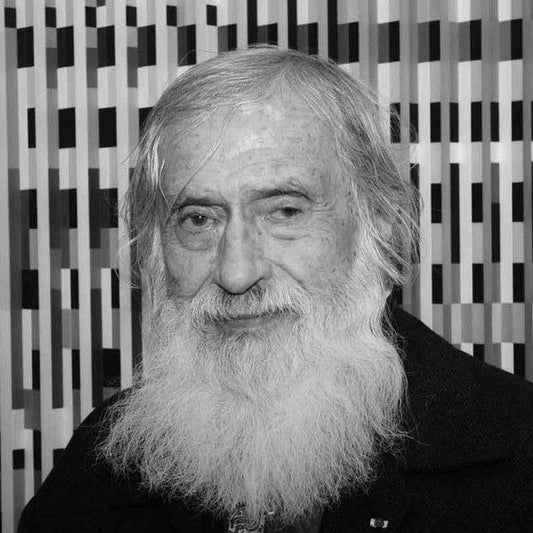
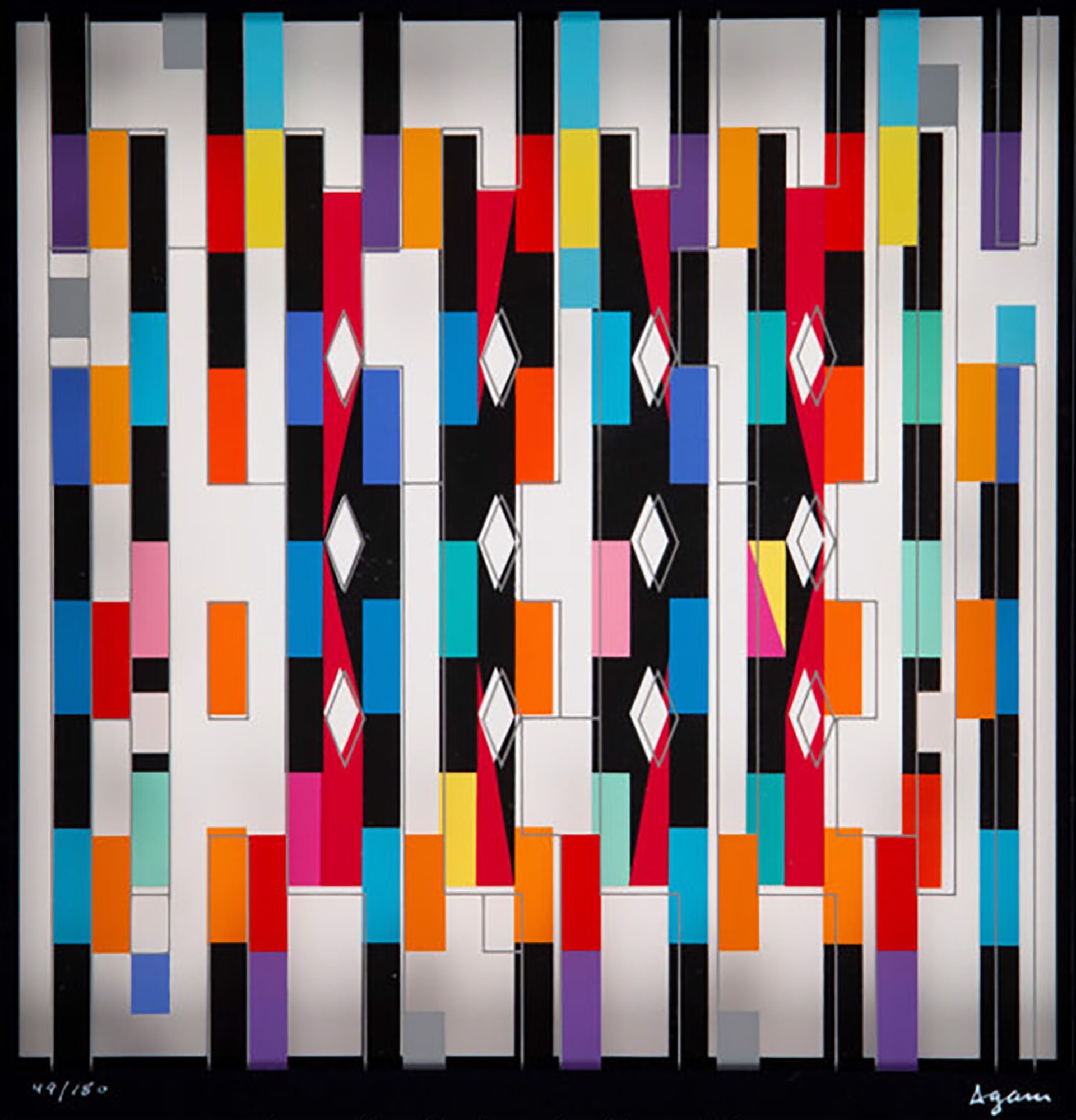
Yaacov Agam (born Yaacov Gipstein, May 11, 1928, in Rishon LeZion, then under the British Mandate of Palestine) is one of the most influential artists of the 20th century, particularly known for his pioneering work in kinetic art and op art. He grew up in a religious Jewish family, the son of an Orthodox rabbi, and received his first formal art education at the Bezalel Academy of Arts and Design in Jerusalem in 1946. In 1950, Agam moved to Zurich to study under Johannes Itten, the renowned color theorist from the Bauhaus school, at the Kunstgewerbeschule. It was during this time that Agam was deeply influenced by the ideas of Frank Lloyd Wright and Siegfried Giedion, particularly their thoughts on the role of time in art and architecture, which resonated with Agam’s view of life as a dynamic, evolving force. Rejecting traditional static concepts of painting and sculpture, Agam sought to create art that reflected continuous change, a concept rooted in the Jewish belief that life is dynamic and ever-evolving. In 1951, Agam moved to Paris, where he connected with Surrealist artists, who were among the first to recognize his talent and encourage him. His first solo exhibition was held in 1953 at Galerie Craven in Paris, featuring kinetic and transformable paintings that engaged the viewer, inviting them to become part of the artwork. This exhibition marked a turning point in his career and attracted significant attention in the art world. In 1955, Agam was recognized as a key figure in the emerging Kinetic Art movement, participating in the landmark exhibition “Le Mouvement” at Galerie Denise René, alongside other notable artists such as Jesús Rafael Soto, Alexander Calder, and Jean Tinguely. Agam’s work is known for its optical nature; the artwork changes depending on the viewer’s perspective, either through physical movement around the piece or by interacting with it directly. He works across various media, including two- and three-dimensional painting, sculpture, ceramics, stained glass, screen printing, lithography, and etching. One of Agam’s most famous inventions is the “Agamograph”, a type of lenticular printing that creates a changing image depending on the viewer’s angle. This innovative technique has become highly sought after by collectors. Agam has also written and published several books about his work, concepts, and exhibitions. Today, he remains one of the most celebrated and successful Israeli artists, continuing to live and work in Paris.