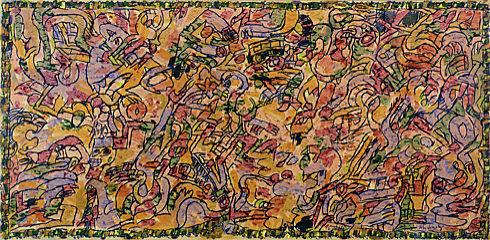
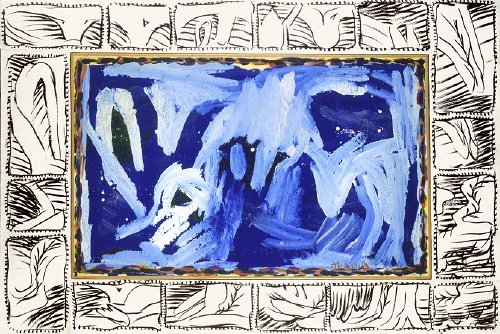
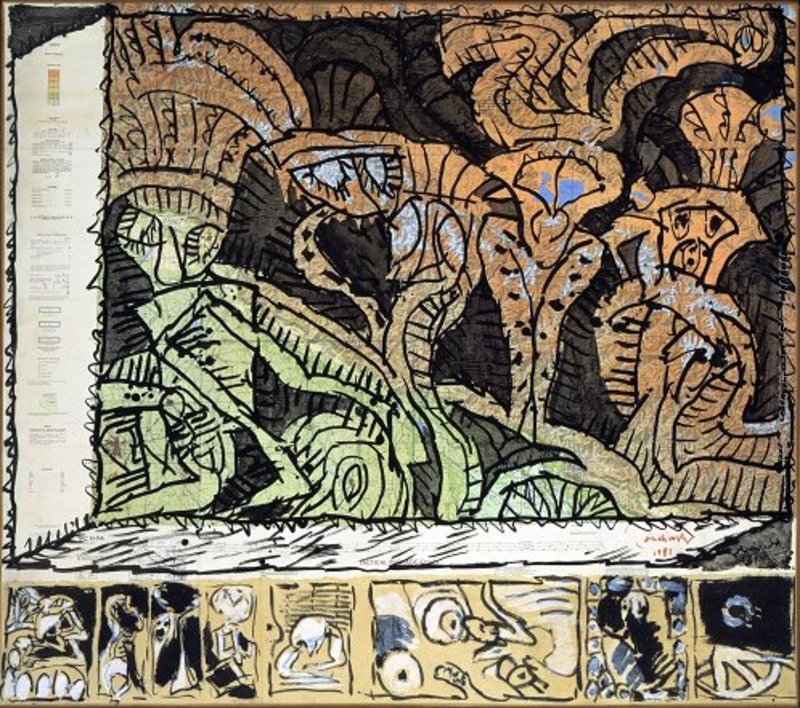
Pierre Alechinsky, born in Brussels on October 19, 1927, was a Belgian painter and printmaker known for his evolving style that transitioned from post-Cubism to Expressionism. He developed an early interest in graphic arts and, in 1944, enrolled at the *École Nationale Supérieure d’Architecture et des Arts Décoratifs* in Brussels, where he studied illustration and typography. His early works, such as those exhibited in 1947 at the Galerie Lou Cosyn in Brussels, depicted distorted and monstrous representations of women, reflecting a strong Expressionist influence. In 1949, Alechinsky joined the CoBrA movement, a group of avant-garde European artists who championed art free from academic constraints. He participated in their first major international exhibition at the Stedelijk Museum in Amsterdam. In 1951, Alechinsky organized a second international exhibition for the group, but soon after, CoBrA disbanded. In 1951, Alechinsky moved to Paris on a French government scholarship to study printmaking. In 1952, he furthered his skills in engraving at Stanley William Hayter’s *Atelier 17*. Fascinated by Japanese calligraphy, he traveled to Japan in 1955, where he visited Tokyo and Kyoto, met masters of the art, and created the famous film *Calligraphie japonaise* (1956). Throughout the 1960s, Alechinsky traveled extensively across Europe, the United States, and Mexico, participating in numerous international exhibitions. In 1965, the Arts Club of Chicago held a retrospective of his work, which was later presented in other museums across the U.S. In 1976, he became the first recipient of the prestigious Andrew W. Mellon Prize, followed by a major retrospective at the Carnegie Institute’s Museum of Art in Pittsburgh the following year. Alechinsky spent much of his life in France, solidifying his reputation as a leading figure in contemporary art.