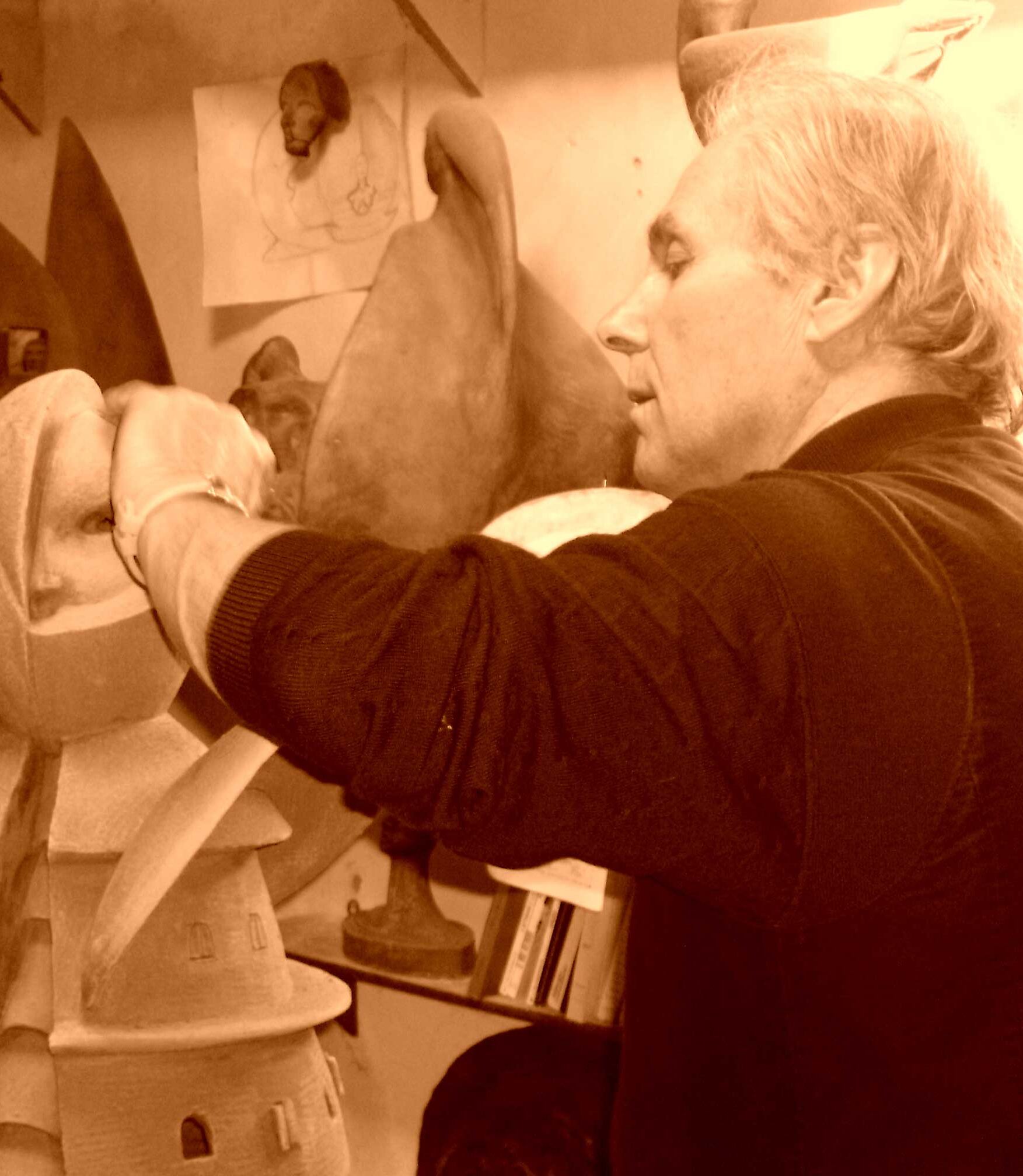
Roberto Molteni
Biography and criticism
A lawyer, painter, and man of letters, he was born in Lecco in 1976 and lives in Galbiate (LC). In 2000 he spent a year in Germany attending the Goethe Universität in Frankfurt, and in 2002 he worked on his degree thesis while traveling during one summer on the road between Austria and Romania. Although he pursued legal studies, he has always cultivated a strong passion for literature and art, and in 2003 he published the poetry collection “The Absolute Artificial”, inspired by French Decadentism and the philosophy of Nietzsche. From 2015 to 2017 he studied under master Vittorio Martinelli, a well-known exponent of Hyperrealism; his first works date back to these years, characterized by a strong hyperrealist imprint in mountain landscapes and female portraits. In 2018 he broke away from Hyperrealism, founding his own artistic movement, defined by art critic Giorgio Gregorio Grasso as “Modificazionism,” or “Impressionist Realism”: the perfection of landscape and naturalistic form is no longer the ultimate goal, but is reinterpreted through colors, perspectives, and humanitas, offering the viewer a new image—while respecting form—rich in hidden meanings not immediately perceptible. In 2020, during the Covid-19 pandemic and also due to restrictions imposed on professional activities, he devoted himself more intensively to art, and his production received a significant boost; in October 2020 he participated for the first time in a group exhibition titled “Democracy in Art” at the Venice Art Gallery in Venice, curated by art critic Giorgio Gregorio Grasso. Also in 2020, he collaborated with writer Anna Giuliano, illustrating each of the seven chapters of the novel “The Interweaving of Love and Psyche” with seven plates, later published in 2021. In September 2021, together with the Municipality of Dolzago, he organized his first solo exhibition entitled “Lights of Modificazionism.” From 2021 to 2023 he took part in numerous group exhibitions in Venice: “Love and Psyche” (October 2021); “Romantic Venice” (February 2022); “Marco Polo – The Silk Road” (September 2022); “Giacomo Casanova” (May 2023). In the spring of 2022 he published his first catalogue, featuring 77 works, entitled “Modificazionism, or the Absolute Artificial,” with the support and critical review of the Venice Art Gallery in Venice. In September 2022 he was invited to the prestigious International Exhibition at Castello del Lupo in Cogliate, where he exhibited alongside artists such as Luna Berlusconi and Maria Kononov. Starting in 2022, he experimented with a new evolution of Modificazionism, approaching geometric abstraction. Colors are cut, decomposed, and fragmented into triangular shards, then recomposed into regular structures made of glass or cardboard, taking the form of circles or regular polygons with an odd number of sides (triangles, pentagons, hendecagons). From February 9 to March 3, 2024, he organized a solo exhibition in Rome at the Fineco Center on Via Tiburtina, entitled “The Poetics of Feeling.” In September 2024 he took part in the international painting competition “Alla Prima” in Cavallino Treporti (Venice), winning the Critics’ Award. From June 24 to 29, 2025, he participated in the international exhibition “Premio Maestri in Beijing,” where his works achieved a coefficient rating of 3.5. In September 2025 he participated in Civitavecchia in the “Odoardo Toti Painting and Sculpture Prize,” receiving a special mention for his abstract work. From October 24 to 26, 2025, he took part in Paris in the 17th edition of the international exhibition “Business Art Fair,” exhibiting three abstract works, later published in the magazine “La Gazette des Arts.”
The works of Roberto Molteni are not defined by geometric lines; they are complex constructions, material structures that depict a background and crystallize here and there into sediment—into all that has remained visible. These are works that do not reflect light, but absorb it, generating a suspended, almost ethereal dimension into which the observer slowly and attentively immerses themself. The reiterated radial forms, at times sharp and at others blurred, allude to something that either expands outward or implodes toward a central point. A sense of motion emerges, seemingly suspended—almost an unfinished gesture—or, conversely, one caught in its full unfolding. This whole can also be read as a co-participation of order, chaos, and fragmentation, between light and the harmony of inner worlds, force fields, and areas that narrate the memory of gestures, materials, and the sedimentation of time. As it advances, the painting is not an empty space to be filled, but a ground to be brought forth. It is an encounter in which matter begins to speak, within the emblematic circle of completion, harmonic fragmentation, and rhythmic materiality. The work, compelling in nature, is an invitation to enter into its motion rather than to uncover a fixed meaning. Far from creating images, Molteni constructs introspective landscapes, fields of force, and mnemonic zones that convey gestures, materials, and temporal stratifications. His works thus appear not as finished images, but as ongoing events, in which philosophical worlds converge within the composition. This coexistence of order and chaos, of density and light, of division and accord, is transformed into a painterly expression that is nearly ancestral. In his research, the painting is a point of origin, in which the observer may recognize something familiar without being able to define it—and precisely for this reason, feel personally addressed. Thus, the viewer of each of Molteni’s works enters its movement, overcome by the negation of perceiving a definitive meaning.
Category of affiliation
- Painting
Technique
Painting
Quotations
The highest market valuation achieved with a painting is €7.000
Critiques received from
Ombretta Del Monte, Giorgio Gregorio Grasso, Sandro Serradifalco

Artworks

Astratto urbano
- 2024
- 120 cm x 80 cm
- Oil on canvas

Luna nera
- 2022
- 14 cm per side
- Mixed technique

Eros Psiche e Tecne
- 2021
- 100 cm x 100 cm
- Oil on canvas