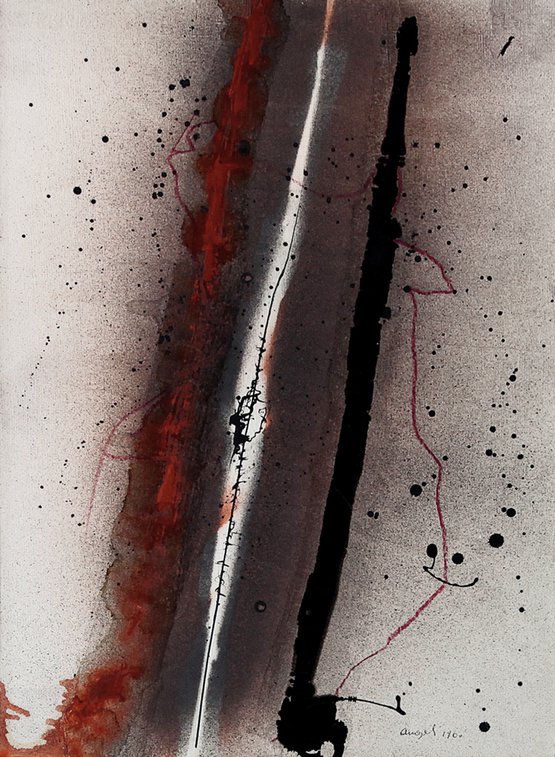
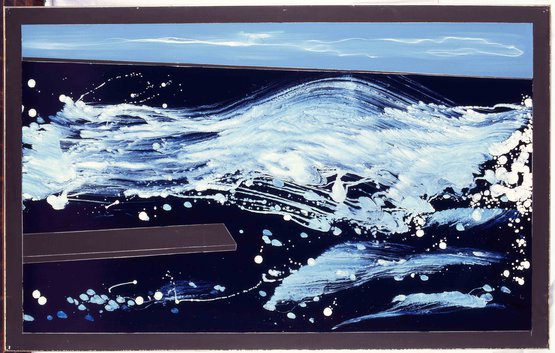
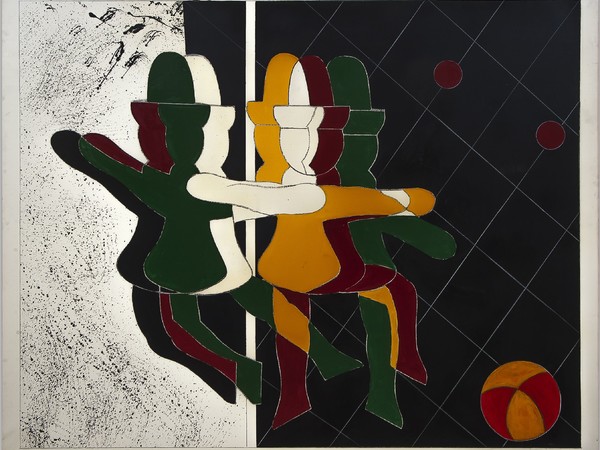
Giuseppe Franco Angeli (1935–1988) was an Italian artist who lived and worked during a turbulent period in European and world history, marked by World War II, the Cold War, and radical social and political movements. Born in Rome’s San Lorenzo district, Angeli grew up in poverty and in an antifascist environment. He developed an interest in art as a self-taught artist, influenced by his life experiences and political activism, initially within the Communist Party and later in Maoist movements. Starting in the 1950s, his art was characterized by a strong political commitment and reflection on violence and historical trauma. His early works were marked by materiality and the memory of the devastation caused by the bombing of San Lorenzo during World War II. His first paintings were described as “wounds” of history, reflecting the pain and destruction suffered by Europe. From the early 1960s, Angeli came into contact with the informal art movement and participated in international exhibitions, engaging with artists such as Alberto Burri and Piero Manzoni. His work evolved to incorporate symbols of power and ideology, such as swastikas, crosses, and crescents, often filtered through the veil of memory and violence, as seen in his “Cemeteries.” In the following years, Angeli explored themes of international politics, such as the Vietnam War, the Chilean coup, and Cold War dynamics, through the use of strong symbols and imagery, including flags and coins. Angeli also created works that reflected the social and political tensions of the time, with a particular focus on violence and class struggle. In the 1970s and 1980s, his work became more reflective and symbolic, dealing with themes such as death, conflict, and historical memory. His production expanded to include new media, such as video and photography, and began to focus on exotic and metaphysical landscapes marked by elements like airplanes and pyramids. In the last years of his life, the figure of the “puppet” emerged as a self-portrait, symbolizing a tragic and ironic view of the human condition. Angeli passed away in Rome in 1988, leaving a legacy of works that combine aesthetic reflection with historical and political testimony, continuing to be relevant for their emotional intensity and social commitment.