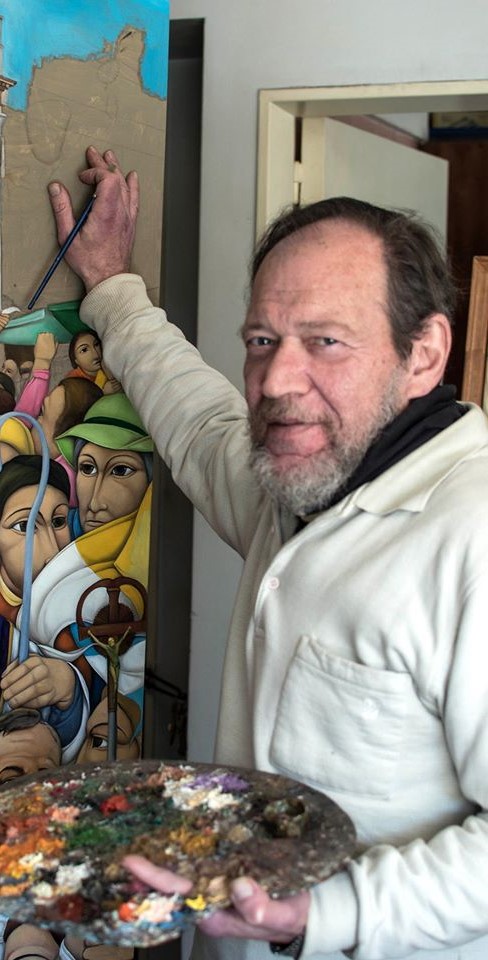
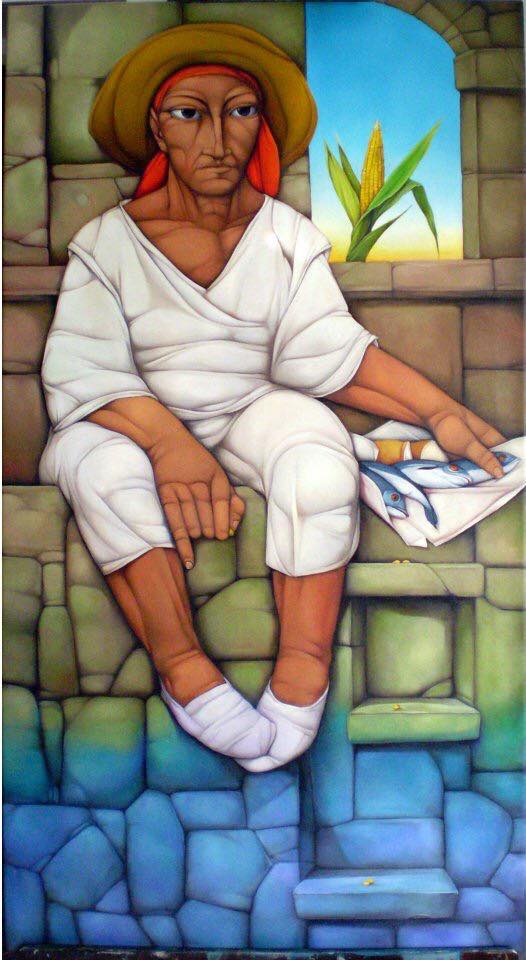
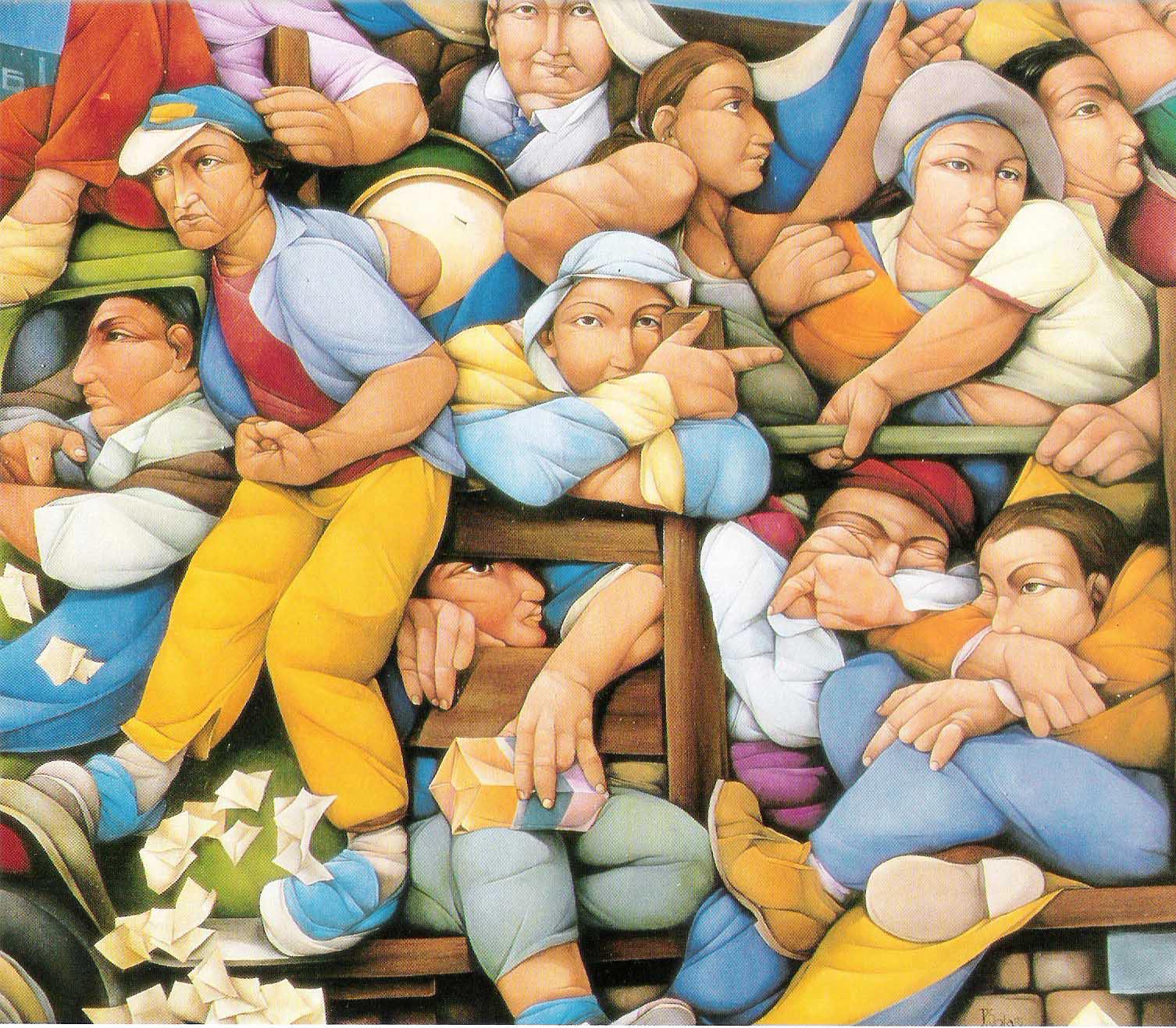
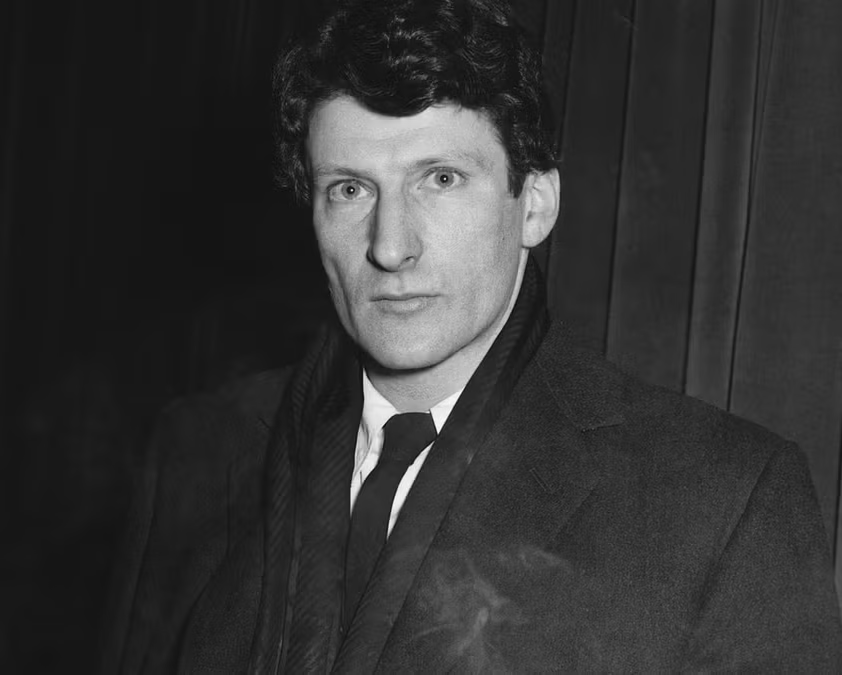
Pablo Solari was one of Argentina’s most significant artists, a painter and sculptor who skillfully blended tradition with innovation to create a unique and universal visual language. Born in 1923 in San Juan, a province in Argentina, Solari grew up surrounded by landscapes and cultural influences that would deeply impact his art. From a young age, he developed a passion for art, honing his talent with a focus on both the natural world and the cultural history of his country. Solari’s formal artistic training began at the National University of San Juan, where he refined his technique. However, it was his experimental approach that allowed him to stand out, combining the influence of major 20th-century movements like abstraction and surrealism with a deep reflection on Argentine cultural roots. His art was not confined to painting alone; he also worked extensively in sculpture, where he found a way to give three-dimensional form to his thoughts and ideas. One of the most distinctive features of Solari’s work was his engagement with monumental sculpture. His ability to work on a large scale allowed him to create pieces that interacted directly with their surroundings. His sculptures, often installed in public spaces, became an integral part of the urban landscape. The use of materials such as iron, stone, and concrete, combined with often abstract forms, brought his creations into dialogue with nature and the architecture of the cities. In this way, his art extended beyond the confines of galleries and museums, becoming part of daily life. Yet Solari’s work was not just about form and material. It was also a way to explore deeper themes related to identity, geography, and the culture of Argentina. His pieces tell stories of people and places, but with a poetic quality that transcends the local and becomes universal. The Argentine landscape, with its mountains and plains, played a central role in his work, often reflecting a symbolic and spiritual vision of that space. The relationship between man and nature, the search for a language that goes beyond words, were recurring themes throughout his career. Throughout his life, Solari was careful not to be defined by dominant artistic movements. While his work was grounded in tradition, his practice was always open to innovation, and each piece was an act of exploration. His art was not simply an interpretation of the world but an experience that deeply engaged the viewer. His visual language acted as a dialogue between forms, colors, and meanings—a continuous experimentation that sought new ways to express the unseen. Over the course of his long career, Solari exhibited in numerous museums and galleries in Argentina and abroad, receiving awards and recognition for his originality. Despite his international fame, his art remained firmly rooted in his Argentine identity, and many of his works are still housed in important private collections and museums today. Solari passed away in 2023 at the age of 100, but his legacy lives on through his works, which continue to inspire new generations of artists. Solari demonstrated that art can be a way to explore the world on a deep and intimate level, while also serving as a means to engage with society and the world at large. His artistic vision—uniting the strength of tradition with the freedom of innovation—has made him a key figure in contemporary art, both in Argentina and globally.