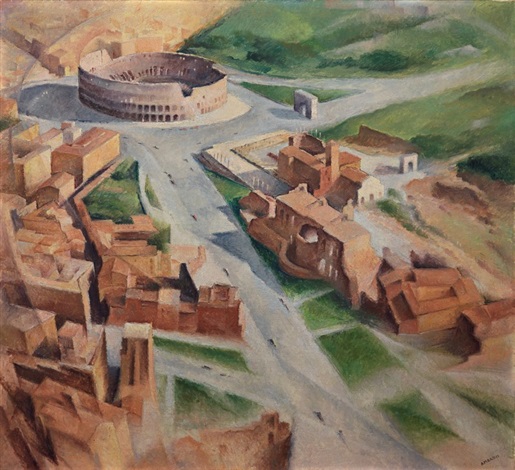
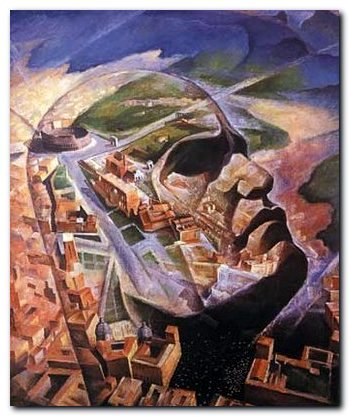
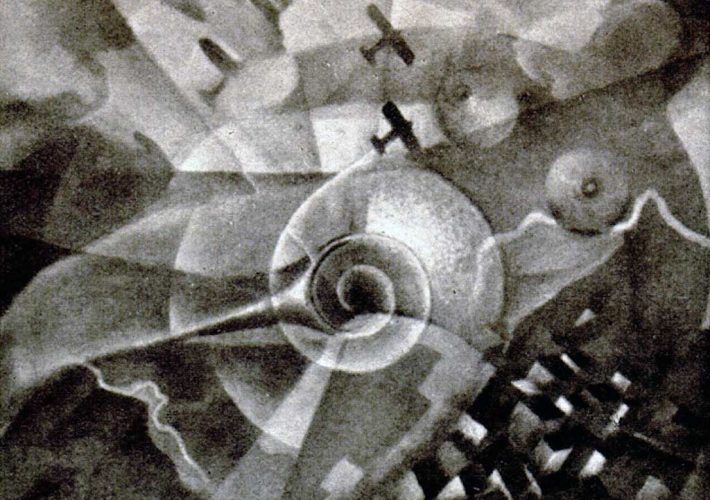
Alfredo Gauro Ambrosi was born in Rome in 1901, but moved to Verona at a young age, where he developed a passion for drawing and painting. He attended the Accademia di Belle Arti Cignaroli as an auditor and, in 1923, decided to emigrate to Brazil in search of better artistic opportunities. In Rio de Janeiro, he worked as an official portraitist for President Arthur Bernardes and spent over two years in South America before returning to Italy in the mid-1920s. Upon his return to Verona, Ambrosi became actively involved in the Futurist movement, specifically the second phase of Futurism known as Aeropittura, which focused on the dynamism and energy of modern technology, particularly aviation. In 1931, he signed the Futurist Letter to F.T. Marinetti and was a founding member of the Verona Futurist Group, with Marinetti’s endorsement. That same year, he gained attention for a dramatic incident during a Futurist theater performance in Verona, where, after being heckled by the audience, he and other performers destroyed the stage—a gesture emblematic of the provocative and bold spirit of Futurism. Throughout the 1930s, Ambrosi focused mainly on aeropainting, creating works that captured aerial views and the sensation of flight. His art often featured dizzying perspectives of cities and landscapes from above, as well as sensual depictions of flying female forms. In 1932, he exhibited at the Venice Biennale for the first time and signed the Futurist Manifesto for the design of an open-air lyric theater at Verona’s Arena, cementing his role as one of the most active cultural figures in the city’s Futurist scene. He also documented the heroic feats of aviation, becoming part of the historical strand of aeropainting championed by Marinetti. Between 1935 and 1943, Ambrosi moved to Rome, where he focused on portraiture, working primarily for Giovanni Caproni di Taliedo. During World War II, he was commissioned by the Ministry of Aeronautics to document the aerial missions of the Italian Air Force, even participating personally in the operations. Many of his late works are dedicated to the themes of war and military aviation, forming the core of his final artistic output. Ambrosi participated in numerous exhibitions throughout his career, including the 1931 Futurist Exhibition of Aeropainting in Milan, where he showcased works like *The Arena from Above* and *Five Thousand Meters*. He also exhibited at various editions of the Rome Quadriennale, with paintings such as *Mussolini the Aviator* and *Aerial War*. His final exhibition at the Quadriennale, in 1943, featured works documenting the aerial bombings and military operations of the war. Ambrosi died in 1945 at the age of 44, leaving behind a significant artistic legacy tied to Aeropittura and Futurism. His work, particularly in its dynamic portrayal of flight and modernity, continued to influence the depiction of aviation and technological progress long after his death.