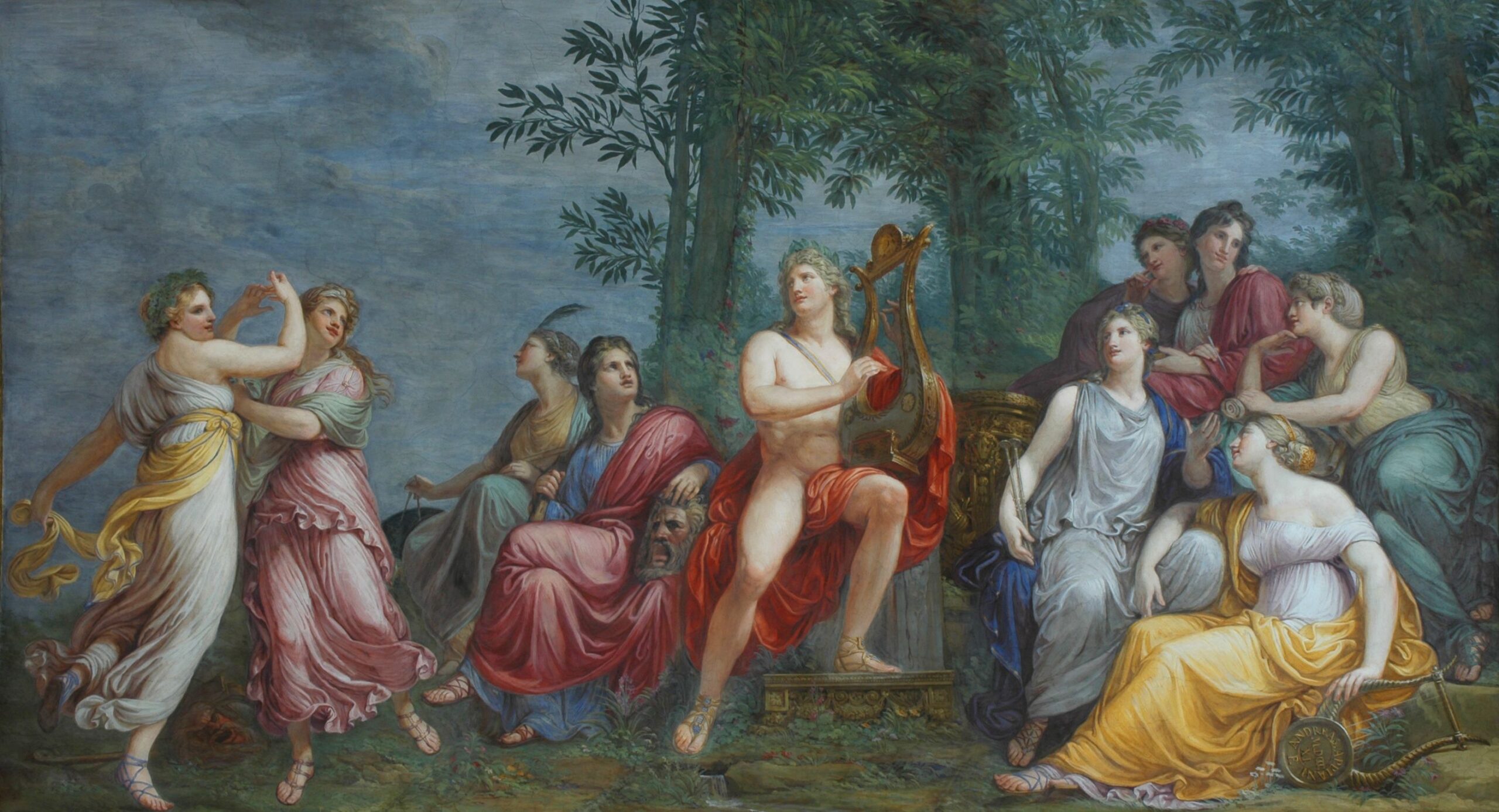
Andrea Appiani was born in Milan on May 31, 1754, to Maria Liverta Jugali and Antonio, a physician. Though initially expected to follow in his father’s footsteps, Appiani, at the age of 15, chose to pursue painting. He studied under Carlo Maria Giudici and then under the fresco artist Antonio De Giorgi at the Accademia Ambrosiana. His education was further enriched by lessons in oil painting from M. Knoller and anatomical studies at the Ospedale Maggiore with Gaetano Monti, a lifelong friend and sculptor. After his father’s death, Appiani faced financial hardship, taking on various jobs, from painting flowers on silk to decorating carriages, before the establishment of the Accademia di Brera in 1776, which gave him the opportunity to pursue a more focused artistic career. Appiani’s early works include the fresco of Saints Gervasius and Protasius in Caglio (1776-1777), and his later works show his involvement in scenography at La Scala, which helped him emerge from obscurity. In the late 1770s, he created four temperas for Count Ercole Silva and began working on religious and mythological themes. By the 1780s, he was increasingly involved in significant projects, including the design of the high altar for Monza Cathedral (1798) and frescoes for various palaces and churches in Milan, such as the Palazzo Diotti and the Church of San Celso. In 1790, Appiani married Costanza Bernabei, a former student, and began a period of intense artistic activity. He undertook a nine-month study tour to Parma, Bologna, Florence, and Rome, preparing for his major fresco project at Santa Maria presso San Celso. His collaboration with the Accademia di Brera continued, and he took on prominent commissions from the Napoleonic regime, including designing allegorical images for official proclamations and creating numerous portraits of notable figures of the time. Appiani’s involvement with the Freemasons during the Napoleonic period saw him become a key figure in Milan’s cultural life. He was appointed to various important positions, including serving as a commissioner for the arts in 1802, and he was even tasked with overseeing the restoration of Leonardo’s *Last Supper*. His artistic talents were recognized by Napoleon, who appointed him the first painter to the King of Italy, and he was awarded numerous honors, including the Legion of Honor. Despite the many public commissions and his prominent role in the neoclassical movement, Appiani’s art remained deeply personal. His style transcended the academic norms of his time, drawing on Renaissance influences rather than the strict doctrines of classical art. His works, such as the frescoes in the Villa Reale in Monza and his mythological paintings, reflect a refined and harmonious vision of beauty. While his later works were often commissioned for state purposes, Appiani managed to imbue them with sincerity and originality. Appiani’s skill as a portraitist was widely acknowledged, with his ability to capture the essence of his subjects—whether aristocrats or intellectuals—becoming one of his defining traits. His portraits of figures like Ugo Foscolo, Napoleon, and others are celebrated for their precision, elegance, and the way they convey the spirit of the time. Appiani’s life and work offer a unique insight into the neoclassical era, blending classical ideals with the vitality of his own artistic vision. Though not regarded as a genius in the conventional sense, he is remembered for his deep understanding of beauty and his ability to adapt and renew classical traditions. His art was both a reflection of his time and a personal reinterpretation of the classical ideals, making him one of the most important Italian painters of the late 18th and early 19th centuries. He passed away in 1817, leaving a legacy of significant works that continue to define the neoclassical style in Italy. His legacy is also marked by his influence on the next generation of artists, including his grandson, also named Andrea Appiani, although his career did not reach the same heights.