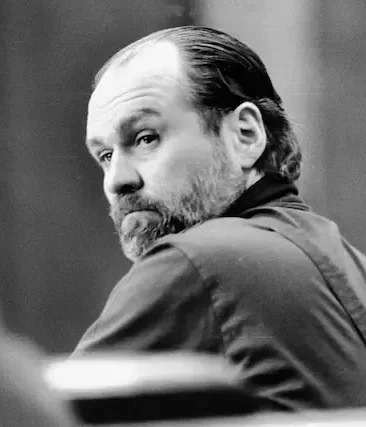
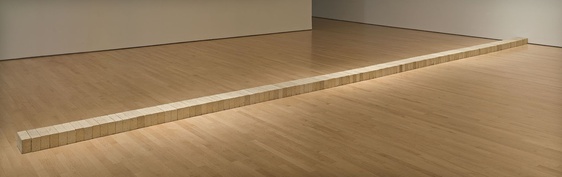
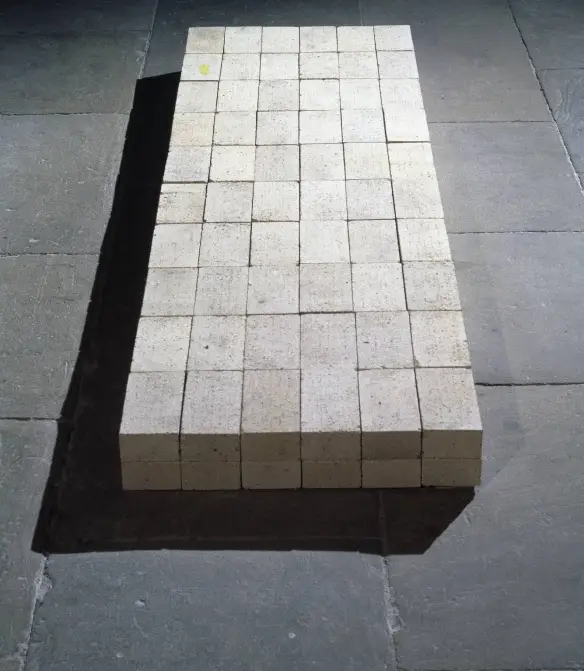
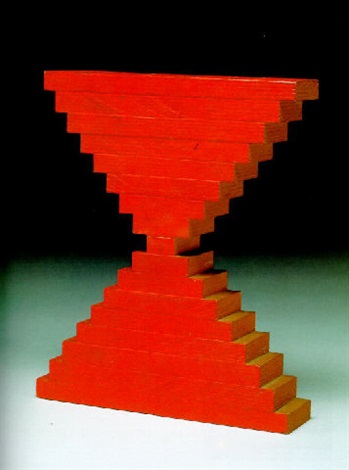
Carl Andre was born on September 16, 1935, in Quincy, Massachusetts. He described his childhood as “wild,” but thanks to his good academic performance, he earned a scholarship to Phillips Academy in Andover, where he began his formal artistic education. After a brief period at Kenyon College in Ohio, from which he was expelled after only two months, Andre spent a year in London. He then served in the U.S. Army’s intelligence unit before eventually enrolling at Northeastern University. However, he left soon after to move to New York in 1957, where he met Constantin Brâncuși and fellow artist Frank Stella, who would also become a key figure in the Minimalist movement. Andre’s approach to art, which sought the essential nature of representation, aligned him with other Minimalist artists like Donald Judd and Dan Flavin. However, his works stood out for their strict physical presence, devoid of the spiritual or emotional tensions often associated with Minimalism. Andre himself described his art as entirely atheistic and deliberately free from sentiment. Between 1960 and 1964, Andre worked as a machinist on freight trains for the Pennsylvania Railroad in New Jersey, dedicating much of his time to poetry. In 1965, he held his first solo exhibition at the Tibor de Nagy Gallery in New York. By the late 1960s, the German entrepreneur Karl Ströher acquired three important works by Andre, which were lent to the Hessisches Landesmuseum in Darmstadt. In the 1970s, Andre began creating large-scale installations, such as *Blocks and Stones* (1973) for the Portland Center for the Visual Arts in Oregon, and outdoor works like *Stone Field Sculpture* (1977) in Hartford. In 1972, the Tate Gallery in London acquired Andre’s *Equivalent VIII*, a piece consisting of 120 bricks. While the work was displayed without incident for years, it became the subject of a major public controversy in 1976 after being featured in the *Sunday Times*. The piece was later defaced with blue food dye. The “brick controversy” became one of the most famous public debates about contemporary art in Britain. In 1979, Andre met artist Ana Mendieta through artists Leon Golub and Nancy Spero at the AIR Gallery in New York. Andre and Mendieta married in 1985, but tragically, on September 8, 1985, Mendieta died after falling from Andre’s 34th-floor apartment. Neighbors reported hearing Mendieta scream, and Andre, in a 911 call, described the incident by saying, “What happened is we had… my wife is an artist, and I am an artist, and we argued about the fact that I was more… well, more exposed to the public than she was, and she went into the bedroom, and I followed her, and she jumped out of the window.” That same night, Andre was charged with second-degree murder, but he was fully acquitted in 1988. Despite the legal outcome, Andre remained a controversial figure, and his exhibitions were often met with protests. In 2015, during a retrospective organized by the Dia Art Foundation, a group of artists staged a performance in which they wept for 20 minutes while walking through the show. In 2017, another protest occurred during the opening of his exhibition at the MOCA in Los Angeles, where demonstrators distributed postcards reading: “Carl Andre is at MOCA. Where is Ana Mendieta?”