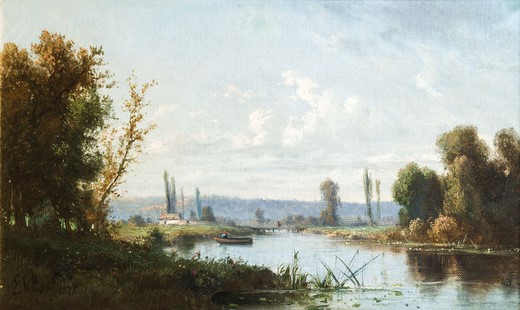
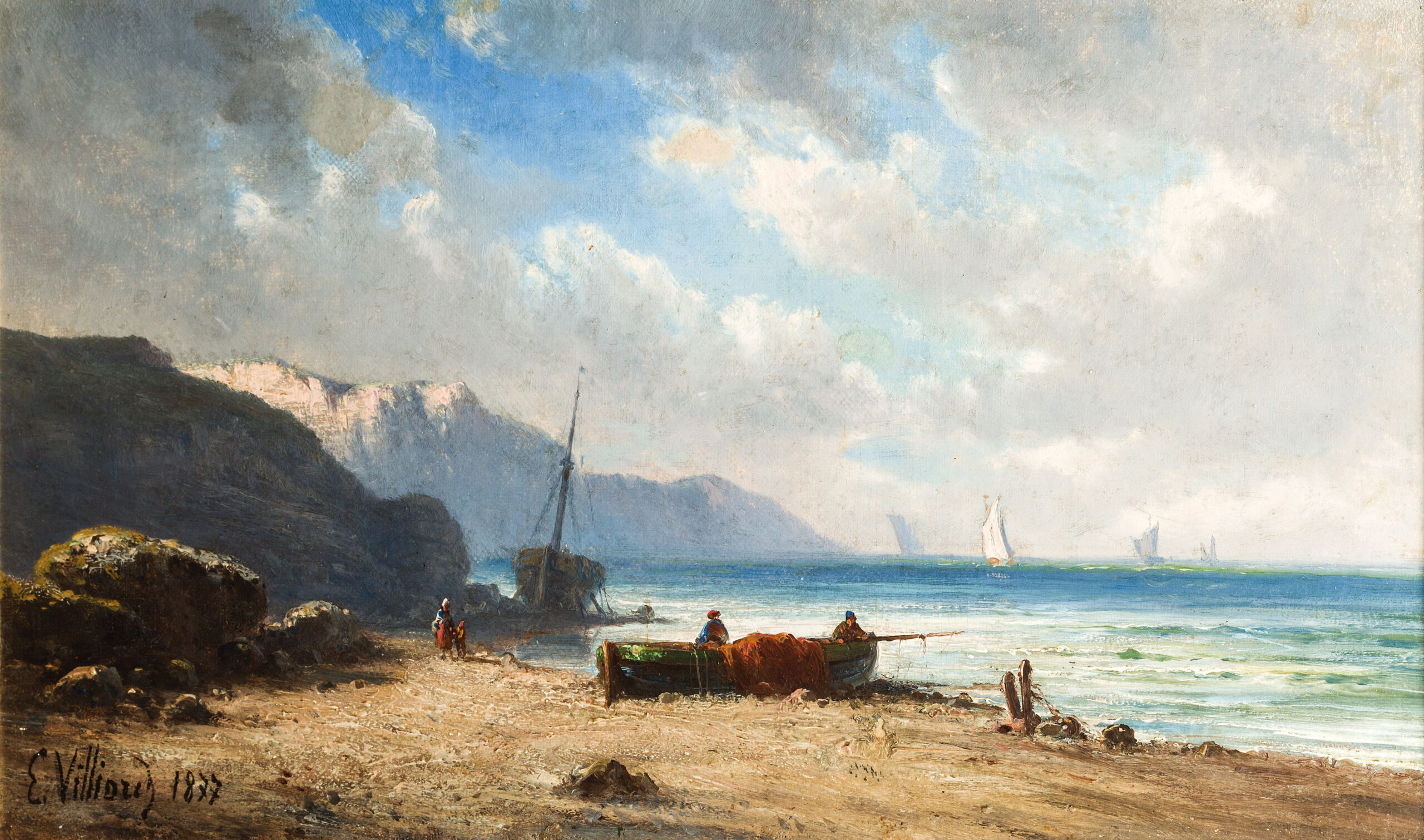
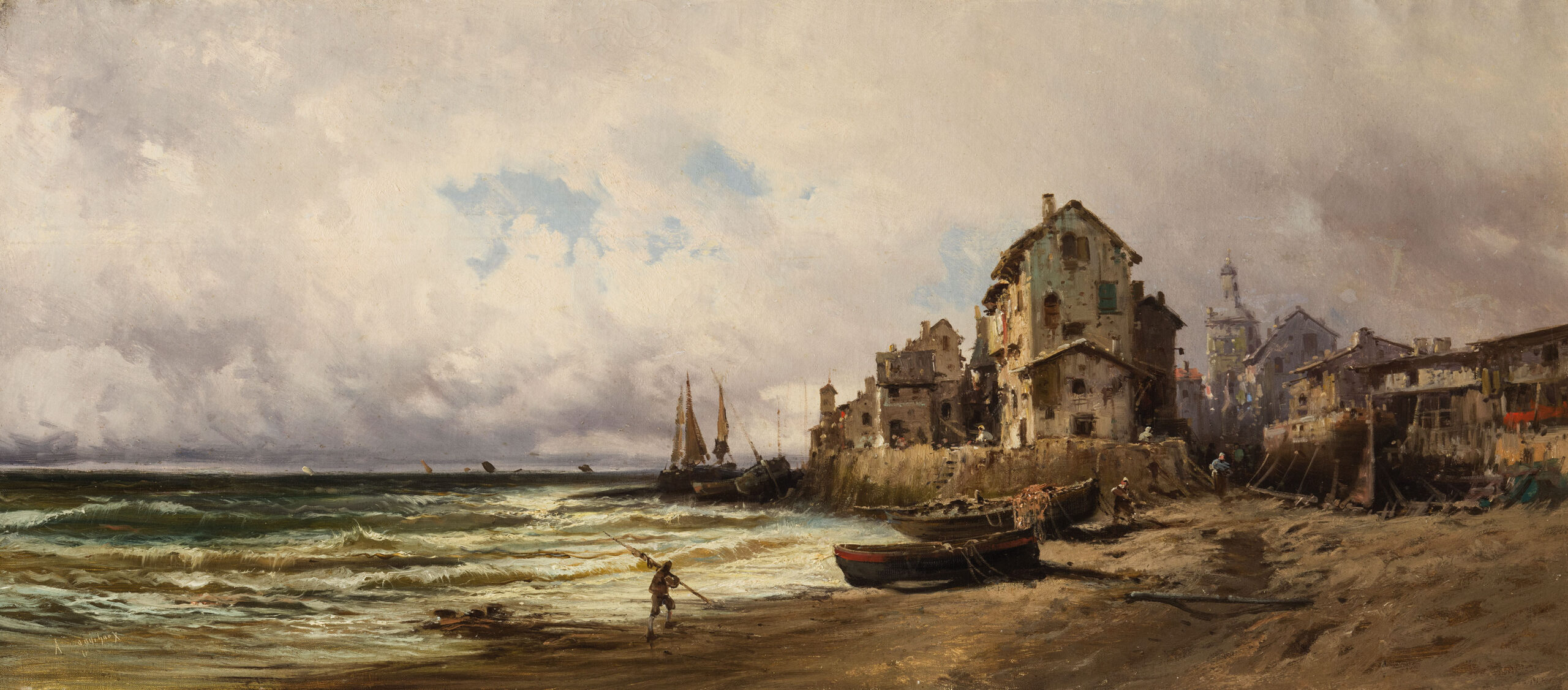
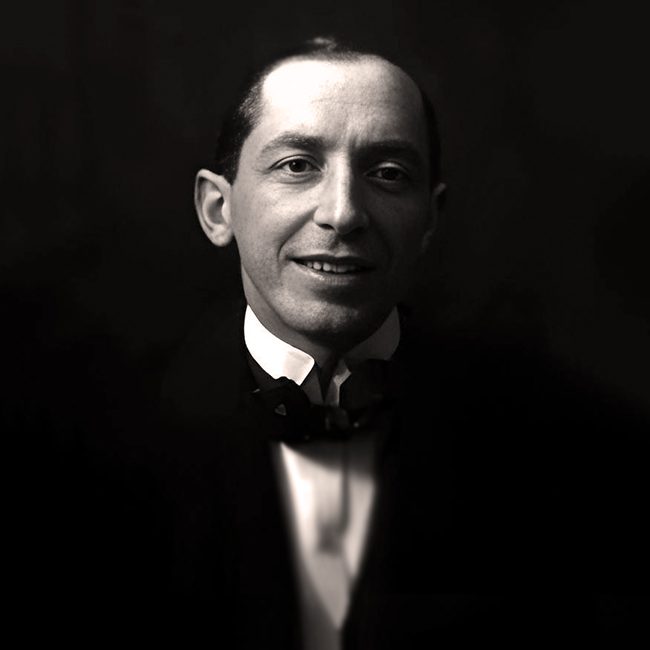
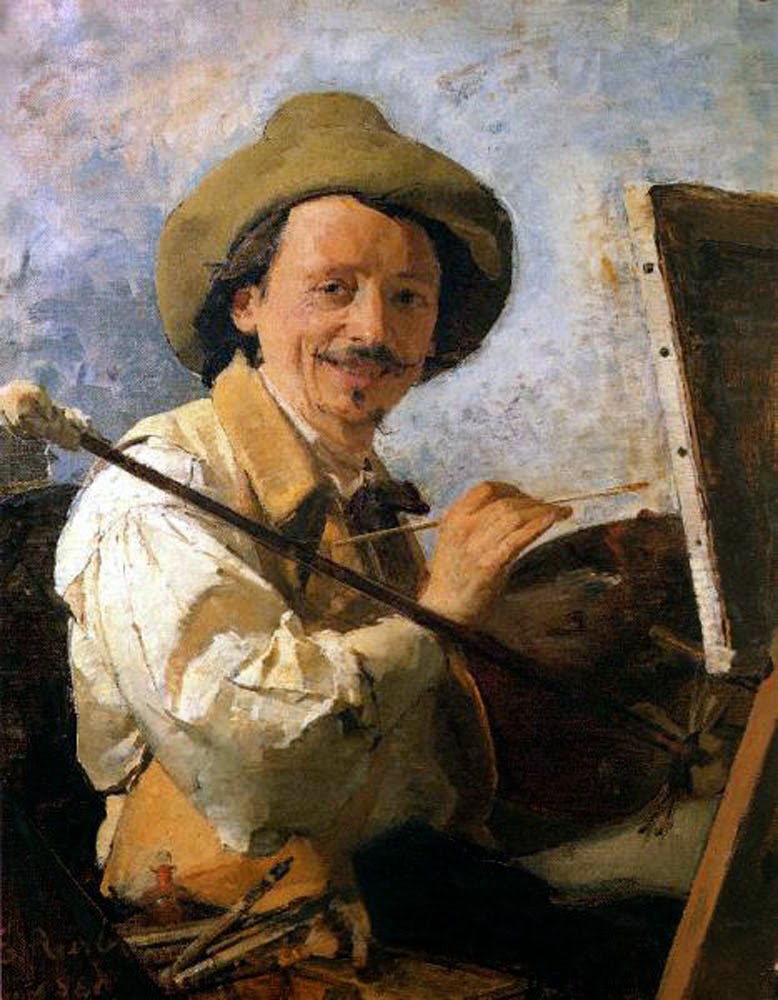
Eugenio Amus was born in Brescia in 1834 and began his artistic journey under the guidance of local masters such as Faustino Joli and Gabriele Rottini. His formal education took him to Milan, where he studied at the **Accademia di Belle Arti di Brera**, and it was here that his talent was fully developed under the influence of Francesco Hayez, a leading figure in Italian Romanticism. Amus quickly specialized in landscape painting, particularly seascapes, creating works that reflected the emotional and sublime qualities of the Romantic ideal, with a deep connection to nature. However, Amus’s career was not limited to painting. He also dabbled in acting, performing as a comic actor in a theater company, an experience that added complexity to his character and artistic vision. In 1859, during the Italian unification, he joined the Garibaldian campaigns, a move that reflected his adventurous spirit and his support for the patriotic ideals of the time. In 1866, Amus moved to Paris, where he continued to work as a landscape painter and participated in the **Salon of 1869**, one of the most important art exhibitions of the period. His travels through Spain, France, England, and America enriched his art, introducing new inspirations that expanded his range of subjects and deepened his Romantic interpretation of the landscape. His involvement in the **Franco-Prussian War** of 1870 further fueled his artistic journey, and the various places he visited shaped his evolving artistic language. Eventually, Amus settled permanently in Bordeaux, where he focused more intently on landscape painting. During these later years, his style became more refined and introspective, moving closer to the French **Realism** that was beginning to emerge. His later landscapes showed greater attention to the atmospheric and light variations of nature, becoming more descriptive and precise in their portrayal of the environment. Though he lived far from his birthplace, Amus maintained close ties with Brescia, especially with the local aristocracy, who commissioned several works from him. He passed away in Bordeaux in 1899, leaving behind a significant artistic legacy. His landscapes, which range from tranquil seascapes to stormy vistas, are appreciated for their ability to evoke a mystical, Romantic atmosphere, with a distinctive use of light and color. His work shows influences both from **Giovanni Canella** and from the **Barbizon School**, particularly in the way he captured light and atmospheric effects. Some of his most famous works include stormy seascapes like *”Burrasca sull’Atlantico”* and *”Marina con pescatori”*, as well as coastal and alpine views. Amus succeeded in blending a faithful depiction of nature with the emotional intensity of Romanticism, creating landscapes that, while true to reality, carry a profound emotional weight. Throughout his career, his style evolved, but he never lost the sense of seeking the sublime and capturing the restlessness that defined the European Romantic movement.