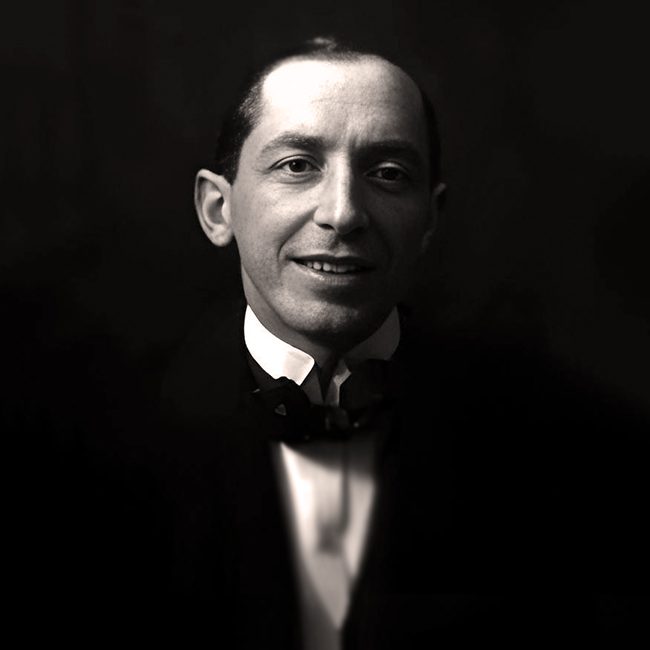
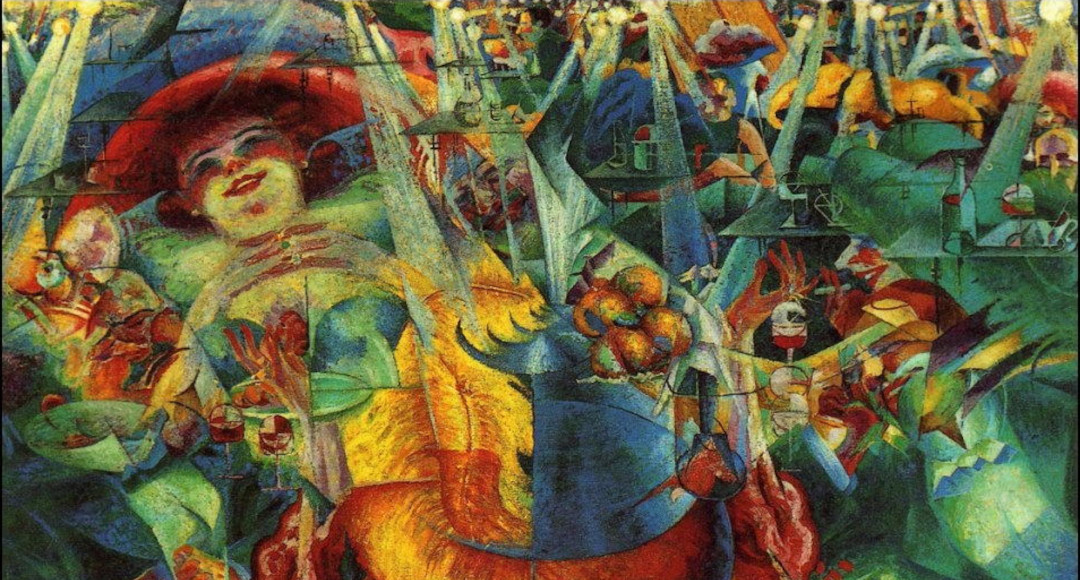
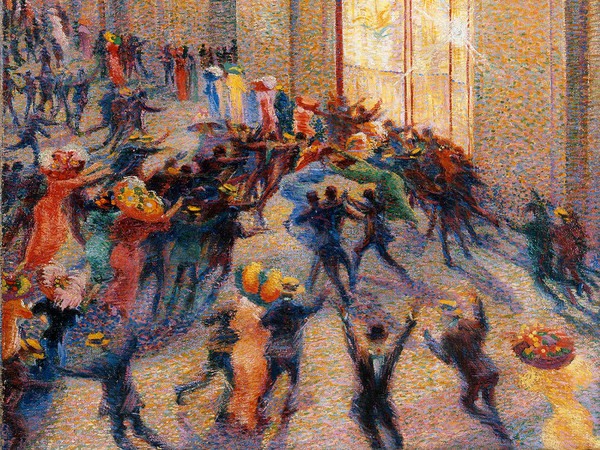
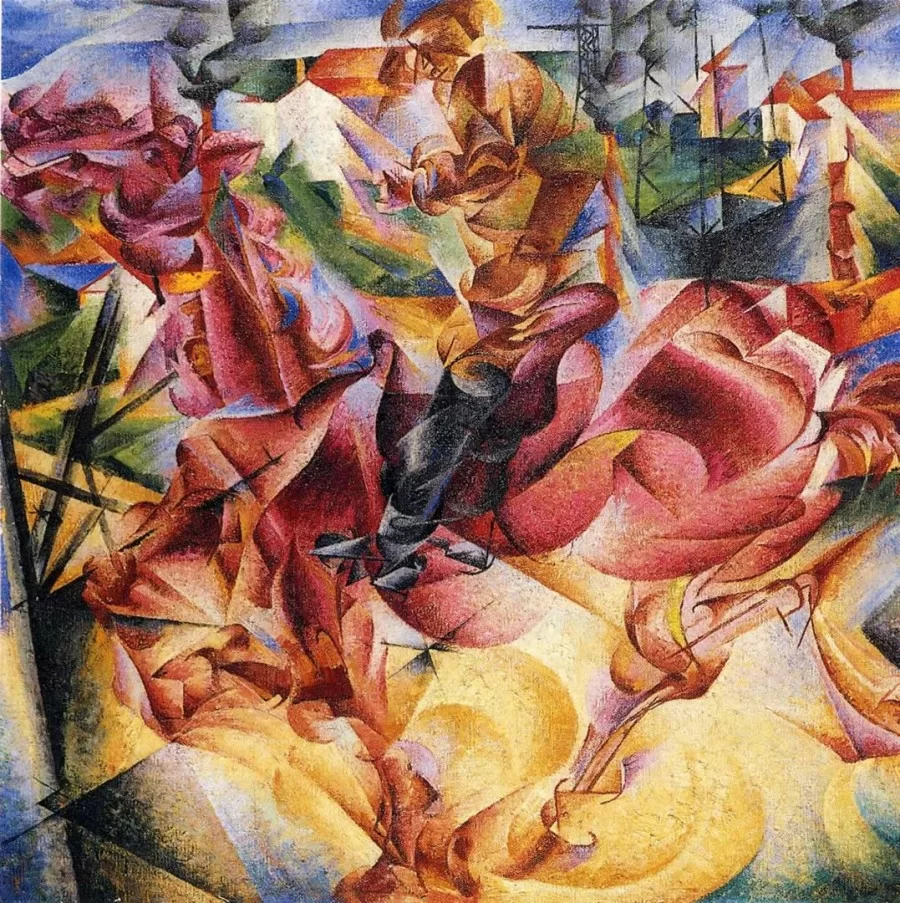
Umberto Boccioni was born in Italy and spent his childhood and youth in various cities due to his father’s frequent relocations, as he worked for the prefecture. In 1901, Boccioni moved to Rome, where he began his artistic career as a designer and illustrator, studying under a poster painter. Here, he became closely associated with Giacomo Balla, who became his great mentor and introduced him to the divisionist technique and the study of light, greatly influencing his artistic development. Balla also played a key role in introducing Boccioni to other young artists, such as Gino Severini. In 1906, Boccioni moved to Paris, where he had the opportunity to study Impressionist painting and the work of Cézanne. During this time, he became acquainted with Augusta Petrovna Popoff, a cultured Russian woman, and with her husband Berdnicoff, he embarked on a five-month journey to Russia. It was during this trip that Boccioni painted the famous “Portrait of Sophie Popoff.” After returning to Italy later that year, he enrolled at the Academy of Fine Arts in Venice. In 1907, after a brief stay in Paris to visit the exhibition of Italian divisionist painters, Boccioni moved to Milan, where he closely studied the work of Giuseppe Pellizza da Volpedo and Gaetano Previati. In 1909, he was deeply struck by the publication of the Futurist Manifesto by Filippo Marinetti, which appeared in the *Figaro*. That same year, Boccioni exhibited his “Portrait of Mrs. Virginia” at the Permanente in Milan, marking an important moment in his career. In February 1910, together with fellow artists Carlo Carrà and Luigi Russolo, Boccioni visited Marinetti, with whom he shared the Futurist vision. Boccioni signed the Manifesto of Futurist Painters and contributed to the development of the Technical Manifesto of Futurist Painting. In the same year, he held his first solo exhibition in Venice at Ca’ Pesaro, presenting 42 works. From 1911 onward, Boccioni became one of the leading promoters of the Futurist movement, actively supporting its initiatives with writings and public interventions. In 1911, he traveled to Paris with Carrà to organize a Futurist exhibition, where he met artists such as Picasso and the poet Apollinaire. In 1912, he participated in the opening of the exhibition *Les Peintres Futuristes Italiens* at the Bernheim-Jeune Gallery in Paris and published the Technical Manifesto of Futurist Sculpture. In 1914, Boccioni published his book *Futurist Painting and Sculpture*, in which he elaborated on concepts such as simultaneous vision, plastic dynamism, and lines of force—key ideas in his artistic theory. The following year, as Italy entered World War I, Boccioni enlisted in the Lombard Volunteer Cyclist and Motorist Battalion. Tragically, in 1916, during a military operation, Boccioni died as a result of a fall from a horse, cutting short his promising artistic career.