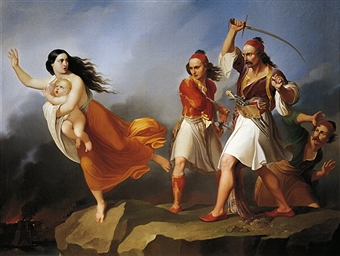
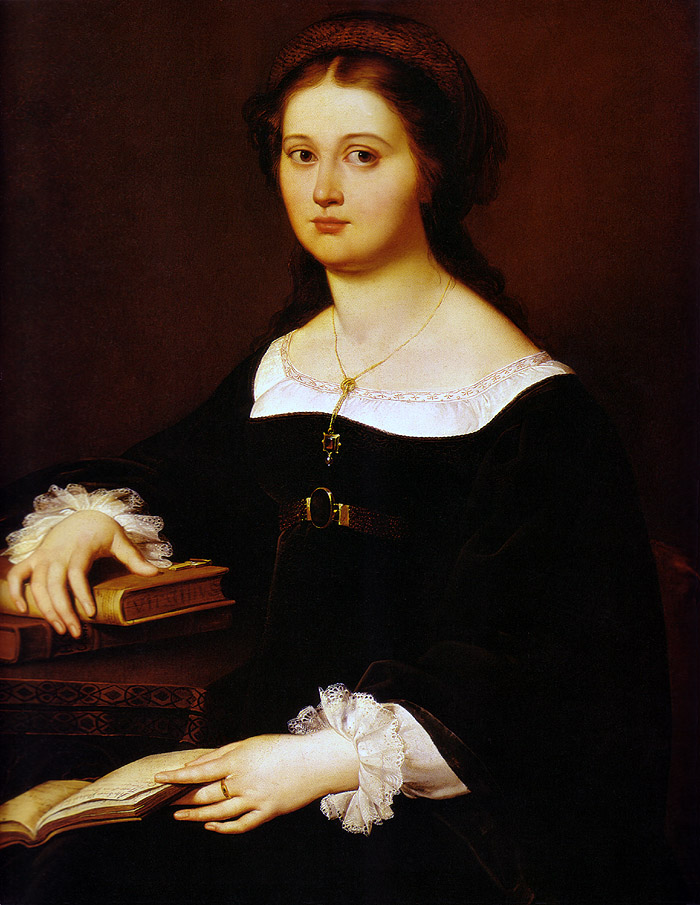
Filippo Agricola was born in 1793 and is recognized as one of Italy’s leading neoclassical painters. He was introduced to painting by his father, Luigi Agricola, an academician and close friend of Antonio Canova, who guided him into the artistic profession. Filippo continued his education at the Accademia Nazionale di San Luca in Rome, studying under the prominent artists Gaspare Landi and Vincenzo Camuccini. In 1812, Agricola won the prestigious “Napoleonic” competition with his painting Mario Meditates on the Ruins of Carthage. This success earned him a three-year pension funded by Canova, marking the beginning of a successful career. Filippo was later admitted with honors to the Accademia di San Luca and eventually appointed as a professor of painting, later rising to the position of president of the academy. Throughout his career, Agricola was in high demand as a portrait artist, receiving commissions from prominent Italian and foreign families. Some of his most notable portraits include those of the Princess of Denmark (1822) and Costanza Perticari Monti, daughter of the famous poet Vincenzo Monti. The portrait of Costanza Monti (1821) was particularly acclaimed, with Monti himself praising the work as a “miracle” rather than just a painting. Agricola was also known for his diptychs inspired by literature, including works such as Dante and Beatrice, Petrarca and Laura, Ariosto and Alessandra, Raphael and the Fornarina, and Tasso and Leonora. His blending of classical themes with literary references earned him the nickname “the Raphael of his time” from Vincenzo Monti, who admired his neoclassical style. In 1839, Filippo Agricola, in his role as sub-inspector of the paintings at the Apostolic Palaces, criticized the restoration work on Raphael’s frescoes in the Vatican Rooms carried out by Carlo Maratta. However, he justified Maratta’s interventions due to the latter’s advanced age and inability to ascend the scaffolding, leaving the restoration work to his assistants. Filippo Agricola died in Rome on December 2, 1857, leaving behind a significant legacy in the neoclassical tradition. His work combined academic rigor with a deep sensitivity to literature and romanticism, securing his place as a key figure in 19th-century Italian art.