Silvano Girardello
Biography and criticism
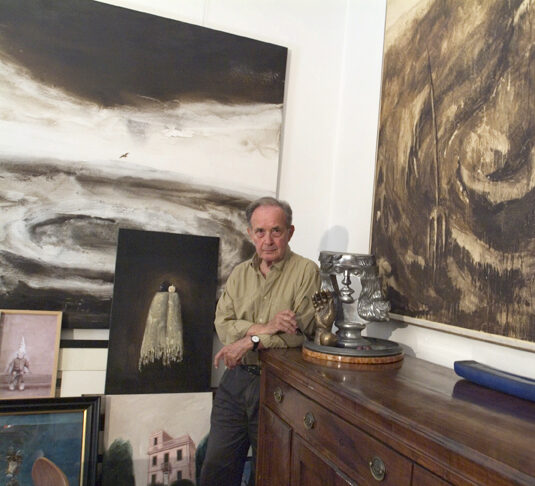
Silvano Girardello was born in Giacciano (RO) on May 27, 1928. In 1933 he moved with his family to Verona. He attended the Teacher Training Institute and the Art High School in Bologna, graduating in 1946. In 1948 he enrolled in the Faculty of Architecture; three years later he left his studies to devote himself to painting. From 1955 onward he taught art education in middle schools. Between 1957 and 1961 he exhibited his first paintings in various group shows. With two works from the Victims series he took part in the Parma Biennale in 1961 and organized his first solo exhibition in the same city, at the Teatro Gallery, presented in the catalog by Arturo Carlo Quintavalle; the exhibition was dedicated to the victims of Hiroshima. His works, marked by a gestural and expressionist approach, define remnants of a tormented humanity reminiscent of Dubuffet, Permeke, Bacon, and Giacometti. In 1964 he began incorporating plastics, photographs, waxed canvases, and newspaper clippings. The series of the little girl with other disturbing presences was born, “Who comes to play with me?” From the mid-1960s, the use of photography became almost exclusive: in his collages he combined, through a grotesque contamination of languages, advertising images and pop culture symbols with a learned iconographic repertoire linked to tradition. In 1966 he held his first solo exhibition in Verona at Galleria Ferrari, presented in the catalog by Licisco Magagnato. In 1967, at Palazzo Strozzi in Florence, he appeared in the group exhibition “Intrarealism.” He also devoted himself to graphic art (photo-litho screenprints), which achieved wide exhibition recognition. In 1969 he exhibited at Galleria dello Scudo in Verona, presented in the catalog by Mario De Micheli. He then returned to painting, mainly using acrylic colors. In 1971 he began the Rape of Europa series, dedicated to the work of Paolo Veronese in the Doge’s Palace in Venice. He addressed politically engaged, ironic, and expressionist works, such as Pinochet and In Death of Luis Carrero Blanco, where echoes of Grosz, Goya, and others can be felt. The series The Visits (1975–1977) also developed along a citation-based poetics. In the late 1970s he turned to a private dimension, portraying family life, interiors, and beloved landscapes. In 1983 he held the solo exhibition Perlustrazioni–non stop at the Palazzo Forti Gallery of Modern Art in Verona. The following year he became Professor of Painting at the Academy of Fine Arts in Verona, later serving as its director. In 1990 he returned with a solo exhibition at Galleria dello Scudo in Verona. In 1992 he exhibited at Galleria Giulia in Rome: these were the years of naturalistic works with rural subjects of strong material impact. In 1995 he held another solo show at Galleria dello Scudo titled “The Angelus,” presented by Luigi Meneghelli. In 1998 the Museum of Modern Art of Gazoldo degli Ippoliti (MN) dedicated a large retrospective to him for the forty years of his career (1958–1998). In 2000 the Municipality of Rovigo, together with the Accademia dei Concordi, dedicated a monographic exhibition to him on the theme “Country Things,” presented by Mauro Corradini. In 2003 he appeared in the exhibition “Anxious Creation,” curated by Giorgio Cortenova, at Palazzo Forti in Verona. Between 2004 and 2006 he returned to the landscapes of his childhood and revisited the authors and works that had marked his path. In 2007 he presented the large four-panel work “The House in Nordstrand” at the exhibition “The Seventh Splendor, The Modernity of Melancholy,” curated by Giorgio Cortenova, held at Palazzo della Ragione in Verona. He passed away in Verona on June 27, 2016. One year after his death, from June 27 to July 16, 2017, the Municipality of Verona dedicated a major retrospective exhibition to him at the Palazzo della Gran Guardia (main floor), curated by the critic Luigi Meneghelli and his wife Carmela with their daughters Anna and Francesca.
The Angelus has represented an essential iconographic reference for many artists: for Van Gogh, the Divisionists, but above all for Salvador Dalí, who made it the object of a feverish investigation, going so far as to identify “the underlying presence of a small coffin, later removed.” Girardello’s approach is neither investigative nor analytical. He does not dwell on probing how much is realistic or “poetic” in the representation of the Angelus: by choosing the two peasants as the protagonists of his work, he does not perform a political or moral operation, but a purely functional one — namely, reactivating the rigidity and inertia of certain aesthetic categories. Thus, the balance and symmetry of the composition become the supporting pillars on which to engage a kind of symbolic duel, extended through numerous variations. The author approaches Millet without ever betraying his own personal style, which is always “preliminary,” primitive, almost pre-linguistic, between the figurative precariousness of Dubuffet and the “rotating touches of earth and black” of early Van Gogh. At times his gaze becomes so sharp that it manages to focus on elements invisible on the surface, such as sediments or geological traces (Angelus no. 95, 1995), or it becomes panoramic, capturing abyssal distances (Angelus no. 42, 1995), or even produces truly off-center framings that dramatically raise the horizon, unbalancing it and pushing the figures to the extreme edge of the painting (Angelus no. 45, 1995). There are images that breathe, open, repeat themselves, and images that seem “made with a trowel, taking from a mountain of natural raw umber earth, unground and thrown on however it comes” (Girardello): and always the two mythic little figures reappear, at times in the foreground, very distant, reiterated silhouettes, engraved marks. Until they leave the scene and the gaze begins to wander across infinite starry skies, over white (or silver) points anchored to blue expanses, like absolute abstract magics.
Category of affiliation
- Painting
Technique
Painting
Quotations
The highest market valuation achieved with a painting is €8.000
Critiques received from
D. Arich De Finetti, G. Bellandi, G. Beringheli, C. Bertoni, M. Brognara, F. Butturini, M. Corradini, G. Cortenova, M. Teresa Ferrari, R. De Grada, M. De Micheli, G. Di Genova, P. Farinati, G. Gigliotti, D. Guzzi, R. Lambarelli, L. Lorenzoni, L. Magagnato, G. Marchiori, D. Marangon, R. Margonari, S. Martini, E. Mascelloni, S. Maugeri, M. Mazza, G.L. Mellini, G. Menato, L. Meneghelli, S. Mozzambani, C. Munari, A. Natali, P. Nuzzo, A.C. Quintavalle, A. Quarta, L. Reggiani, A. Romagnolo, R. Sanesi, G. Seveso, F. Sossi, N. Stringa, T. Toniato, G.L. Verzellesi, F. Vincitorio
Artworks

Angelus n. 5
- 1993
- 160 cm x 180 cm
- Mixed media on parchment paper

Coppia
- 1988
- 188 cm x 188 cm
- Oil on coated paper

Donna e Gallina n.2
- 1988
- 170 cm x 185 cm
- Oil and paints on canvas


