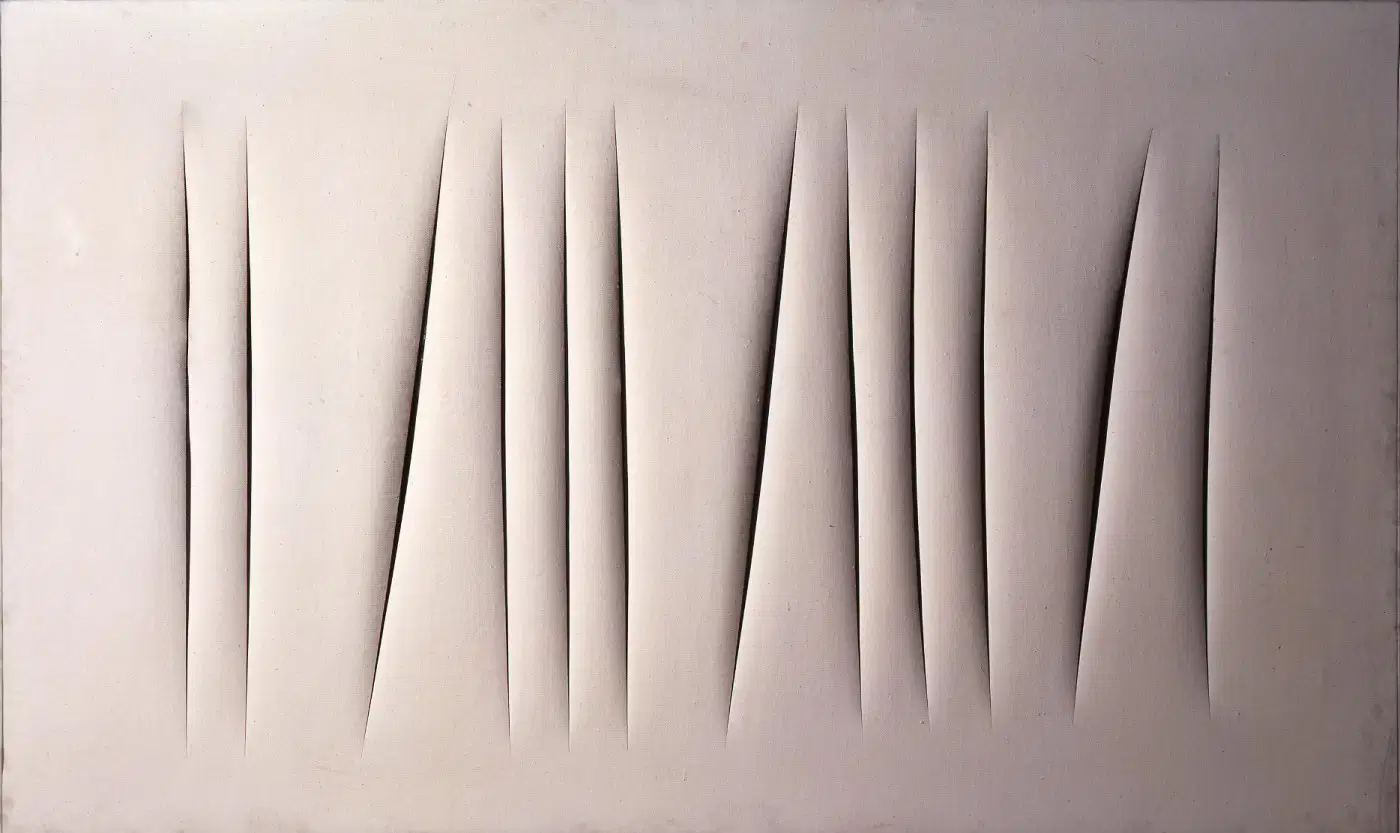
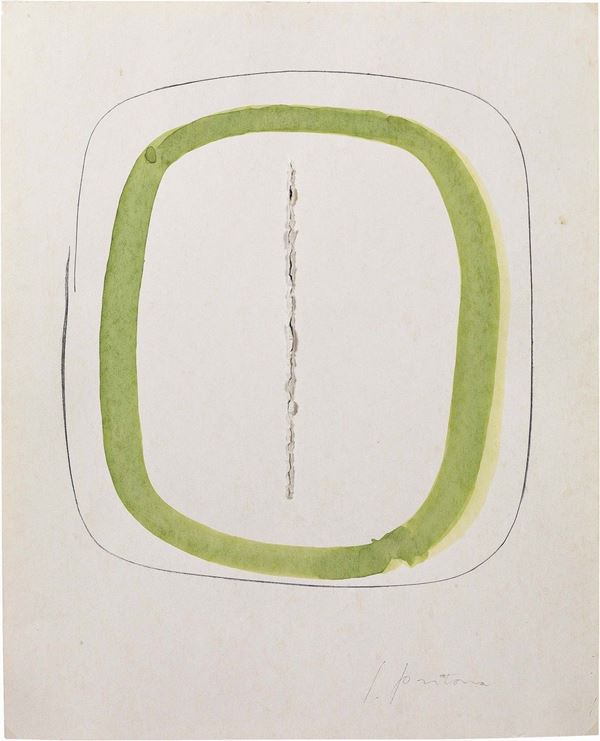
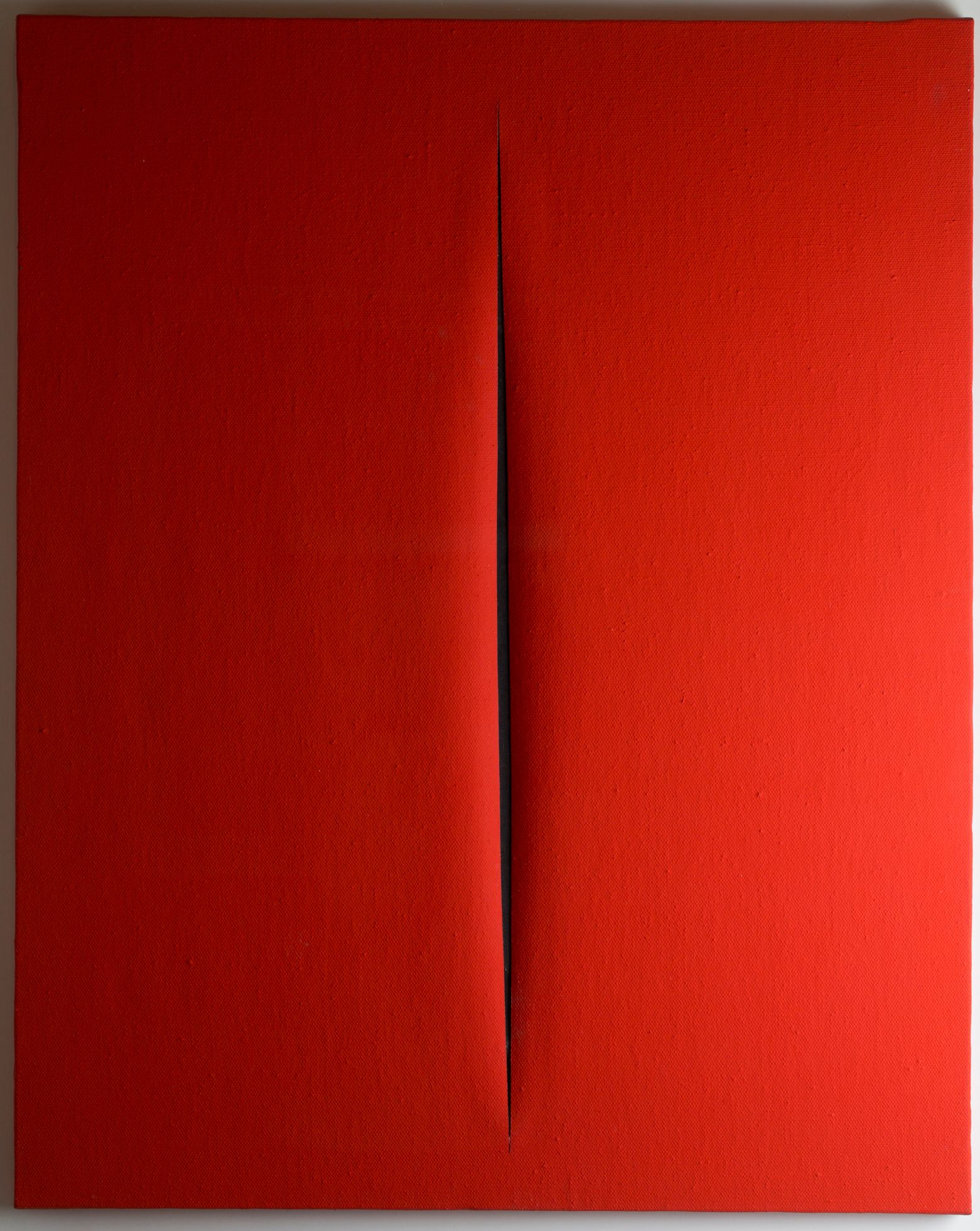
Lucio Fontana, born in Rosario di Santa Fé, Argentina, in 1899, was an artist whose works sparked both admiration and confusion. His famous *Concetti Spaziali*, particularly his “holes” and “cuts,” continue to provoke strong reactions, even today. Yet, these works are considered groundbreaking, marking a pivotal shift in the history of art. What stands out in Fontana’s art is less the simplicity of their technical execution, which was more complex than it appeared, and more the journey he took to arrive at these radical ideas. His *Concetti Spaziali* essentially broke with traditional concepts of painting and sculpture, creating a rupture in the artistic landscape. Fontana, who strongly identified as Argentine, was deeply influenced by his cultural heritage and the idea of space as a dynamic, evolving force. He was one of the key figures in the development of Spatialism, a movement that sought to transcend the flat, static boundaries of traditional art. In his earlier years, Fontana experimented with different materials, such as gypsum, bronze, and ceramics, before arriving at his most famous works. His exploration of space was rooted in the ideas of Umberto Boccioni, whose work on the “fourth dimension” inspired Fontana’s belief that art should break free from the confines of two-dimensionality and sculpture’s static nature. Fontana’s path to these innovations was not immediate. Initially, he worked in sculpture, influenced by the Baroque period’s emphasis on movement and light. His ceramic works from the 1930s, particularly those created in collaboration with ceramist Giuseppe Mazzotti, reflect this Baroque dynamism. It wasn’t until the late 1940s, after extensive experimentation, that he arrived at the revolutionary cuts and holes that defined his later work. Born to Italian parents—his father a sculptor and his mother an actress—Fontana was exposed to the arts early on. He was educated in Italy, where he studied at the Brera Academy in Milan. There, he trained under the sculptor Adolfo Wildt, whose influence was significant early in Fontana’s career. However, Fontana’s artistic evolution took him far from Wildt’s traditionalism. His first major break came with the 1930 Venice Biennale, where his sculpture *Uomo Nero* caused a rupture with his mentor. By the late 1930s, Fontana was experimenting with ceramics and gaining recognition for his innovative works. During World War II, Fontana moved to Argentina, where he taught at the Academy of Fine Arts in Buenos Aires and became involved in the *Manifesto Blanco*, a key document in the birth of Spatialism. It was in Argentina that Fontana developed his first *Concetti spaziali* and, in 1947, he co-authored the *Manifesto dello spazialismo* with fellow artists. His return to Italy in 1949 marked the beginning of his most renowned period, with his first neon *ambienti spaziali* shown at the 1951 Milan Triennale. The 1950s saw Fontana’s exploration of the hole and cut, concepts that would define his legacy. The cuts, introduced in 1958, were first displayed in Milan in 1959, before being showcased at prestigious venues such as Documenta in Kassel and the São Paulo Biennale. Fontana continued to explore new media, working with ceramics in Albissola Marina and pursuing other innovative projects such as the *Olii*, *Metalli*, and *Teatrini*. Fontana’s later years were marked by continued experimentation, even as his health declined. He passed away in 1968 in Comabbio, leaving behind a profound and lasting influence on modern art. Despite facing criticism and misunderstanding during his life, Fontana’s work has since been embraced, with his vision of expanding art into space continuing to inspire artists and thinkers across generations.