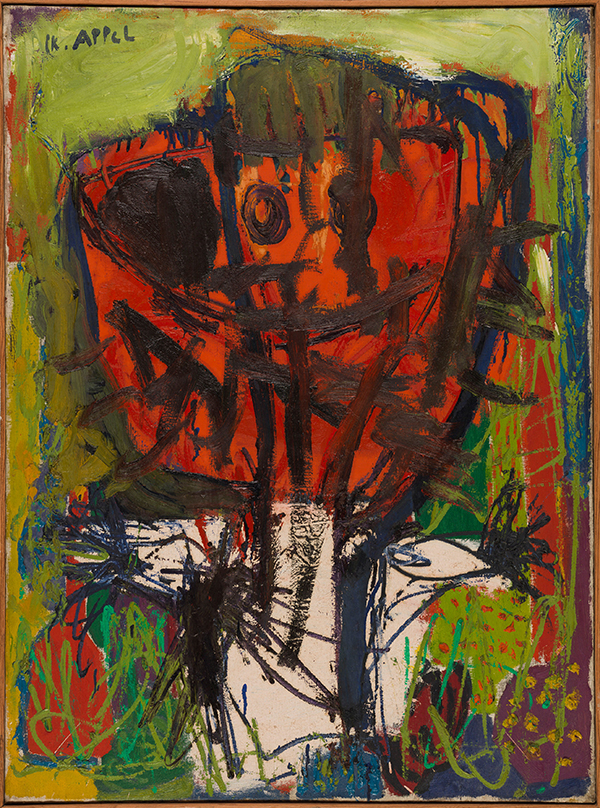
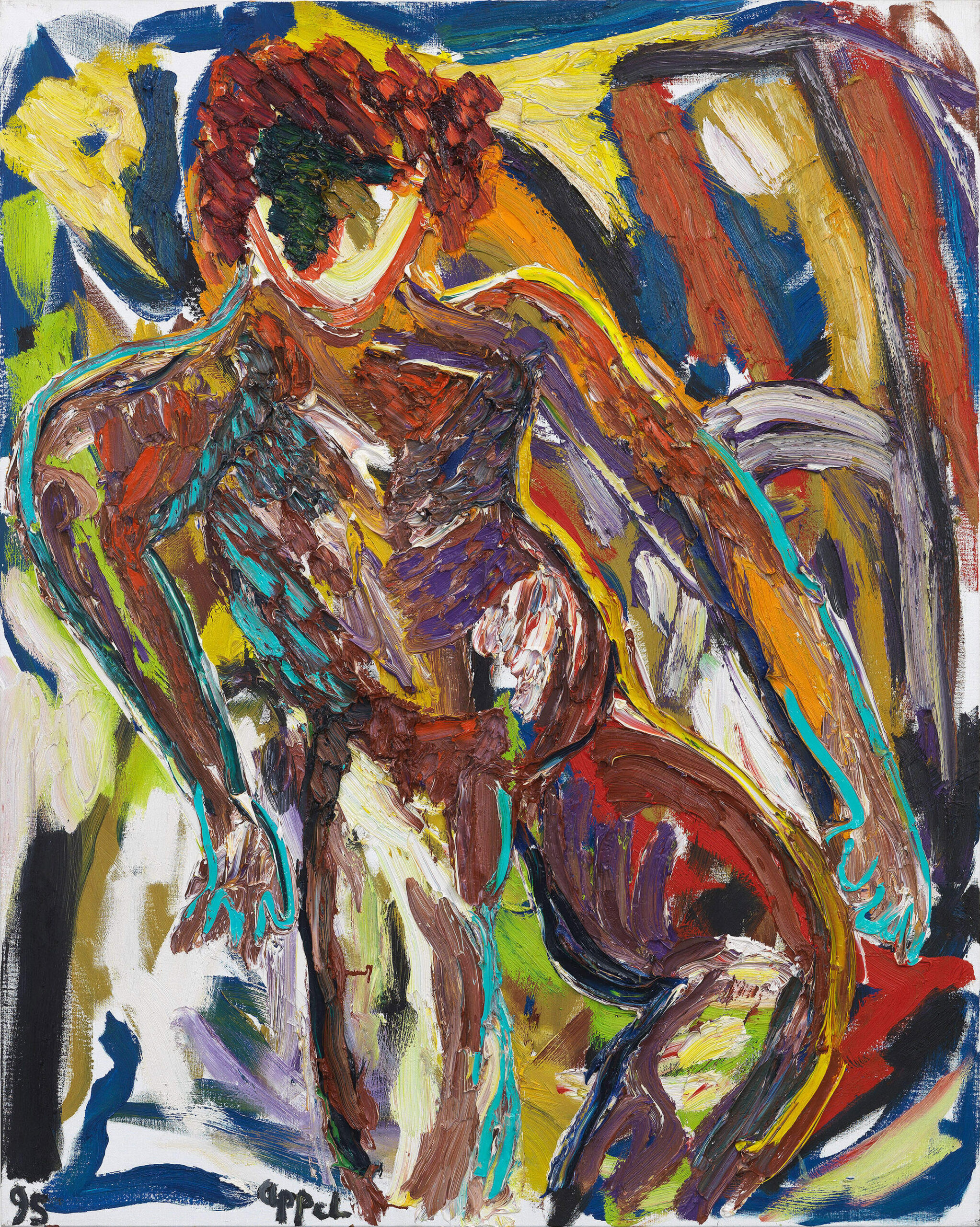
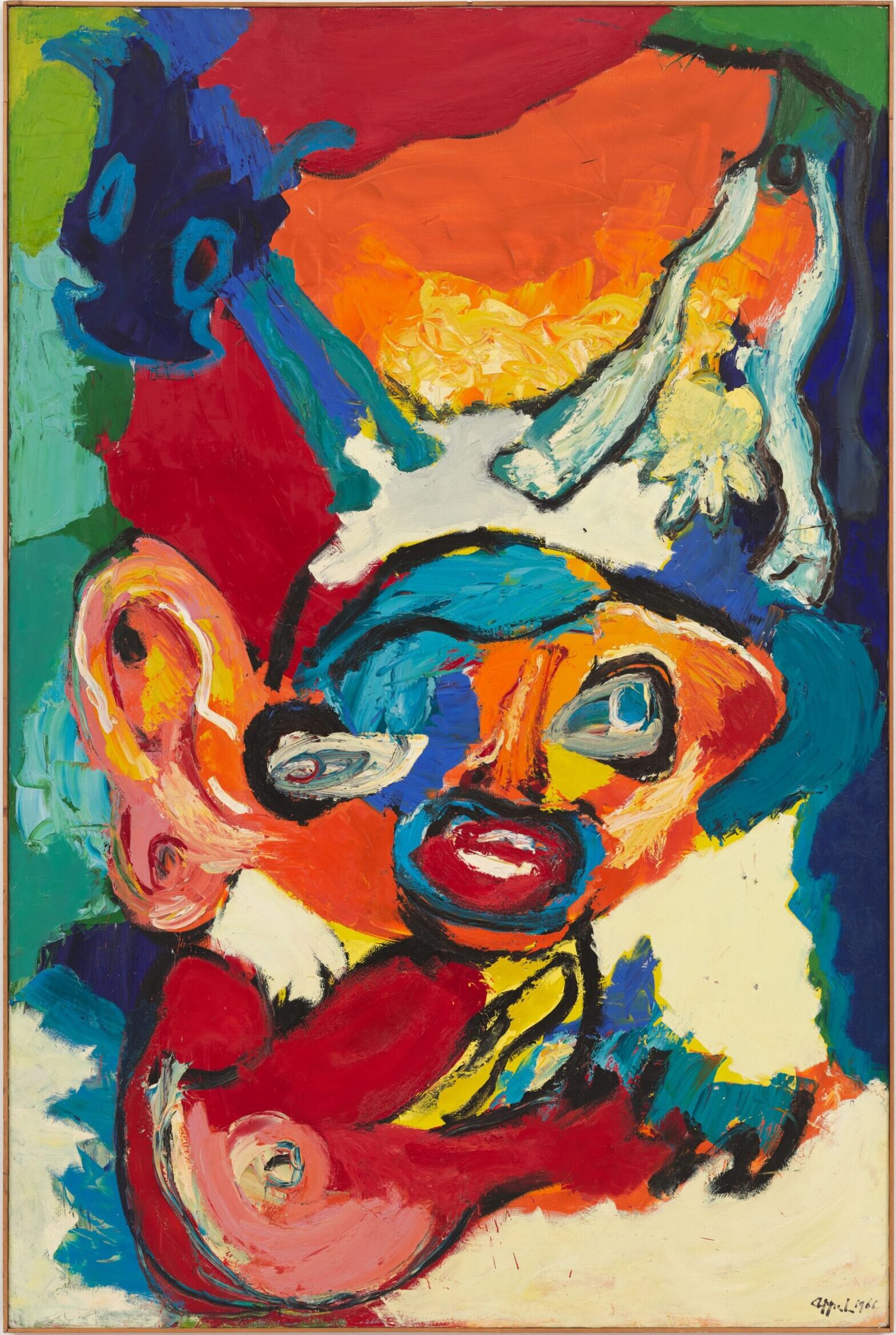
Karel Appel was born in Amsterdam in 1921. He received his artistic training in the city and held his first solo exhibition there in 1946. Initially connected to the Dutch movement “Reflex,” Appel co-founded the “Cobra Group” in 1949, alongside Corneille and Jorn. From that point onward, his work became closely associated with the rapid spread of the Cobra movement across Europe, and he was featured in numerous exhibitions. In 1953, the Palais des Beaux-Arts in Brussels hosted a solo show dedicated to him; in 1954, he exhibited for the first time in Paris at the Facchetti Gallery. His work was also presented in three major retrospectives in 1961 at museums in Pasadena, Phoenix, and Santa Barbara, and in 1965 at museums in Göteborg, Brussels, Amsterdam, and Stockholm. More recent exhibitions include those at the Musée d’Art Moderne in Paris (1968) and the Art Gallery of Toronto (1973). The expressive power of Appel’s painting stems from the philosophy of the Cobra movement, which he embraced and expanded upon. His works are defined by the evocative and vibrant quality of the paint itself—rich, barbaric, and striking. Especially in his early works, under the influence of American Abstract Expressionism, there is a pronounced gestural violence in his style. In his later works, however, this intensity gives way to a more playful and ironic dimension, with a greater focus on constructive elements. Starting in 1968, Appel began creating assemblages that were framed within bold color zones, and more recently, he has produced painted wooden sculptures, further exploring form and texture in three-dimensional space.