Banksy
Biography and criticism
Banksy is a pseudonym used by a renowned British street artist, painter, political activist, and filmmaker, whose true identity remains a mystery. Despite his anonymity, Banksy has become one of the most influential and discussed contemporary artists. Born between 1972 and 1975 in Bristol, England, Banksy’s work is marked by strong political and social messages, often presented through graffiti, murals, and provocative installations. His art, found worldwide, addresses themes such as social injustice, politics, war, and consumerism, and is known for its sharp, satirical style. He rose to fame in the 1990s in Bristol, a city with a vibrant street art scene. Banksy’s works, which often feature animals, human figures, and biting political messages, stand out for their distinctive style. One of his most iconic pieces, “Girl with a Balloon,” depicts a young girl reaching for a red heart-shaped balloon. This image has become synonymous with Banksy’s art. Despite his growing popularity, Banksy has consistently protected his anonymity, rarely giving interviews or appearing in public. His work has been featured in numerous exhibitions around the world, attracting the attention of art collectors and admirers. In addition to his street art, Banksy expanded his creative endeavors with larger, more engaged projects. In 2010, he directed the documentary “Exit Through the Gift Shop,” exploring the world of street art, which earned multiple nominations and awards. He also created installations like “Dismaland,” an anti-Disneyland theme park in 2015 that challenged corporate and cultural ideals. Banksy’s art has sparked varied reactions. Some view him as a creative genius conveying important social messages, while others consider him a vandal for defacing public property. Despite the controversies, Banksy has undoubtedly become one of the most enigmatic and influential artists of our time, with a lasting impact on popular culture and contemporary art. His ability to make people reflect on pressing social issues through street art has made his work both powerful and globally recognized. Beyond his street art, Banksy is also known for his activism. Many of his pieces address social and political issues, such as economic inequality, the refugee crisis, war, and oppression. He uses art to raise important questions about society and challenge the injustices of the modern world. His murals are often paired with sharp, provocative captions that urge viewers to think critically about the messages conveyed. The mystery surrounding Banksy’s identity only adds to his allure. While there has been much speculation, the artist has managed to keep his true name secret, fueling public fascination. This anonymity has helped cement Banksy’s status as one of the most captivating and enigmatic figures in contemporary art. Banksy’s sense of humor is also a hallmark of his work. Many of his pieces reflect a playful, irreverent spirit, exemplified by the famous incident when one of his artworks was sold at auction for a million pounds and immediately self-destructed via a hidden device in the frame. This provocative act sparked global debates on art, the art market, and the meaning of value in contemporary art. Despite the anonymity and controversies surrounding his work, Banksy has made an indelible mark on the history of modern art. His ability to challenge the system and deliver powerful messages through his art has made it some of the most iconic of our time. Through his graffiti, installations, and paintings, Banksy has inspired generations of artists, activists, and audiences, demonstrating the transformative power of art in addressing the most urgent social and political issues of our era. The name “Banksy” is a pseudonym the artist adopted to maintain his anonymity. His true identity remains one of the greatest mysteries in contemporary art. The origin of the name has never been officially confirmed by Banksy, but there are several theories. One popular theory suggests that it is a combination of “Banks,” a long-time friend of the artist, and “Cheesy,” another friend from his circle. Initially, Banksy signed his works with the name “Robin” or “Robin Gunningham,” a name associated with a man thought to be linked to the artist. However, the name “Banksy” became his trademark. The artist has emphasized that maintaining anonymity was crucial to his career, allowing him to create provocative street art without revealing his true identity. This secrecy has helped keep his work in the public eye and fueled the intrigue surrounding his persona. Banksy’s artistic style is recognizable for its combination of graffiti, political satire, humor, and sharp social messages. His technique is largely based on stencils, which allow him to create intricate and detailed works relatively quickly. Using stencils, Banksy can reproduce his images consistently, which is especially useful for his street art, often created in public spaces discreetly. His works are frequently charged with political and social content, addressing topics like war, poverty, inequality, injustice, and consumerism. The images are often provocative, pushing viewers to reflect on contemporary societal issues. Humor plays an important role in many of Banksy’s creations, with comedic or paradoxical situations that encourage both reflection and laughter, offering a critical and ironic perspective on serious topics. Moreover, Banksy is known for blending traditional art with contemporary themes. His works often feature historical figures, like Napoleon or the Mona Lisa, placed in modern contexts or reimagined with a satirical twist, conveying a sense of continuity between the past and present. Banksy’s approach to painting is also tactile. He often uses spray-painting techniques to create abstract and atmospheric backgrounds, layering stencils over these to create striking contrasts between sharp lines and soft hues. Finally, the ephemeral nature of his work is a fundamental aspect of his style. Many of Banksy’s works are painted on public walls or temporary locations, making them vulnerable to removal, vandalism, or decay. This impermanence underscores the message of rebellion against the institutionalization of art, giving his work a transient and precious quality. In summary, Banksy’s style is a unique blend of technique, social and political content, humor, historical references, and contemporary contextualization. This combination has made his work one of the most recognizable and influential in contemporary art.
Category of affiliation
- Painting

Artworks
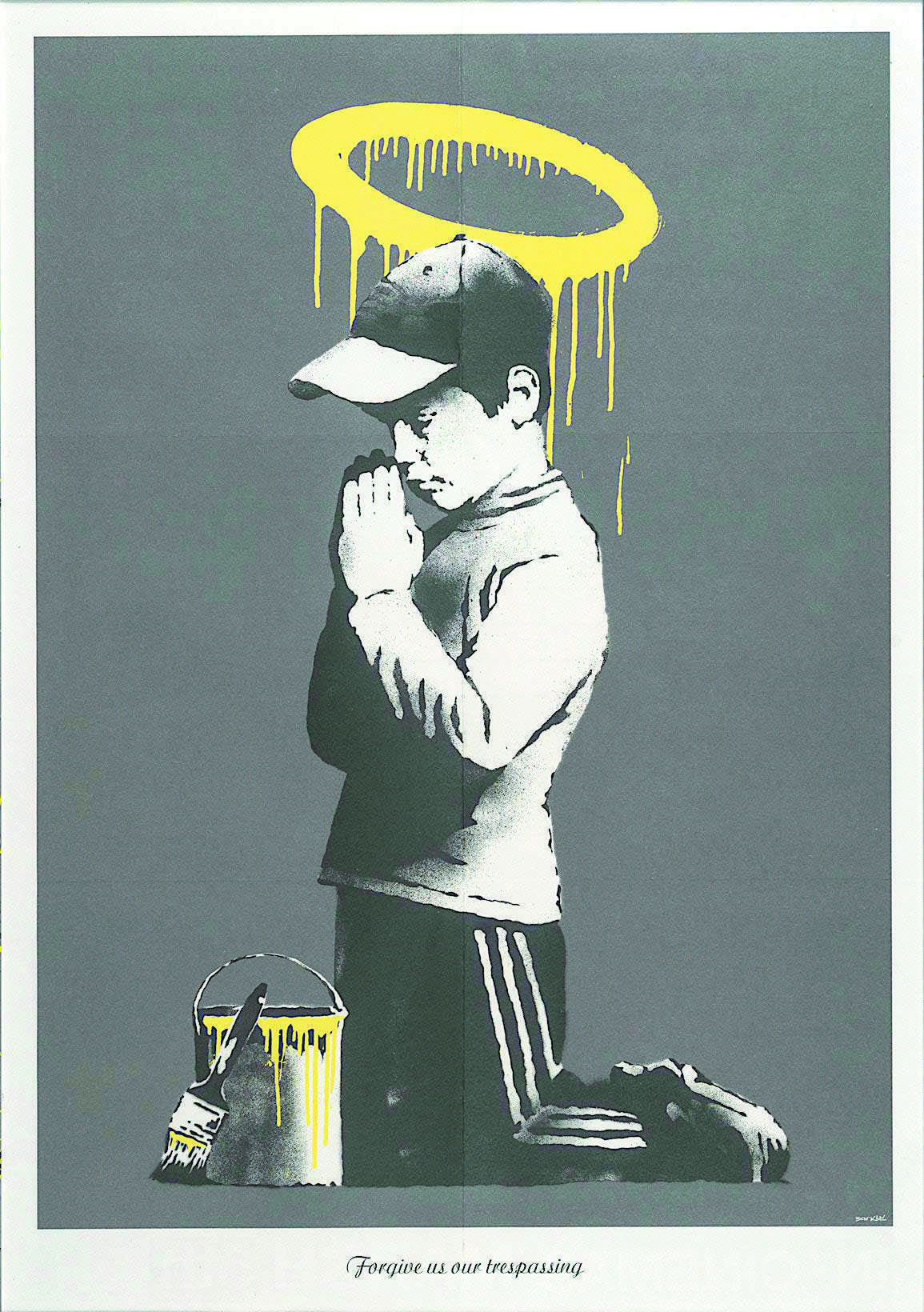
Forgive Us Our Trespassing
- 2011
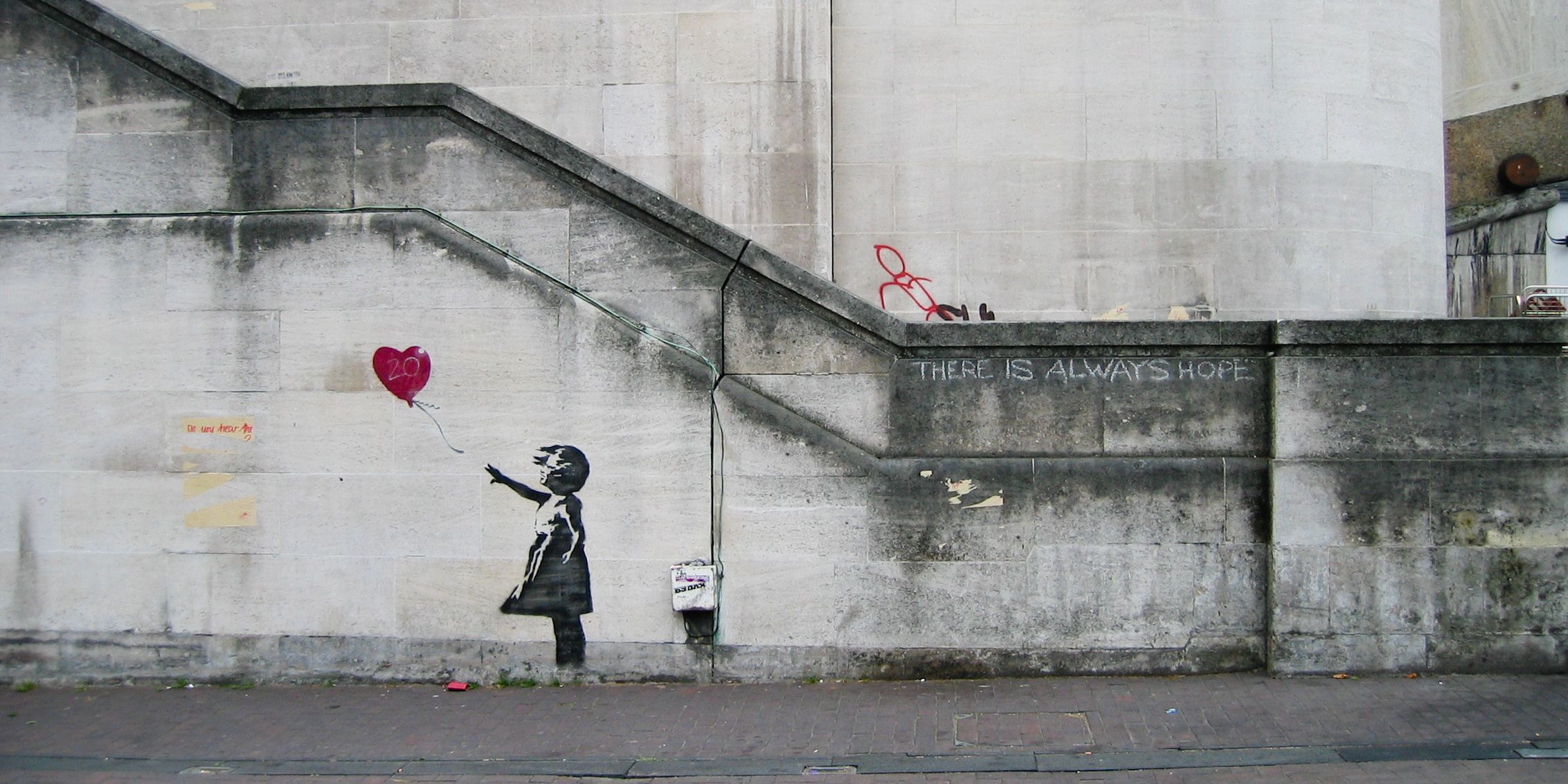
Girl with Balloon
- 2002
- Black stencil silhouette

Pulp Fiction
- 2004
- 70 cm x 50 cm
- Serigraphy