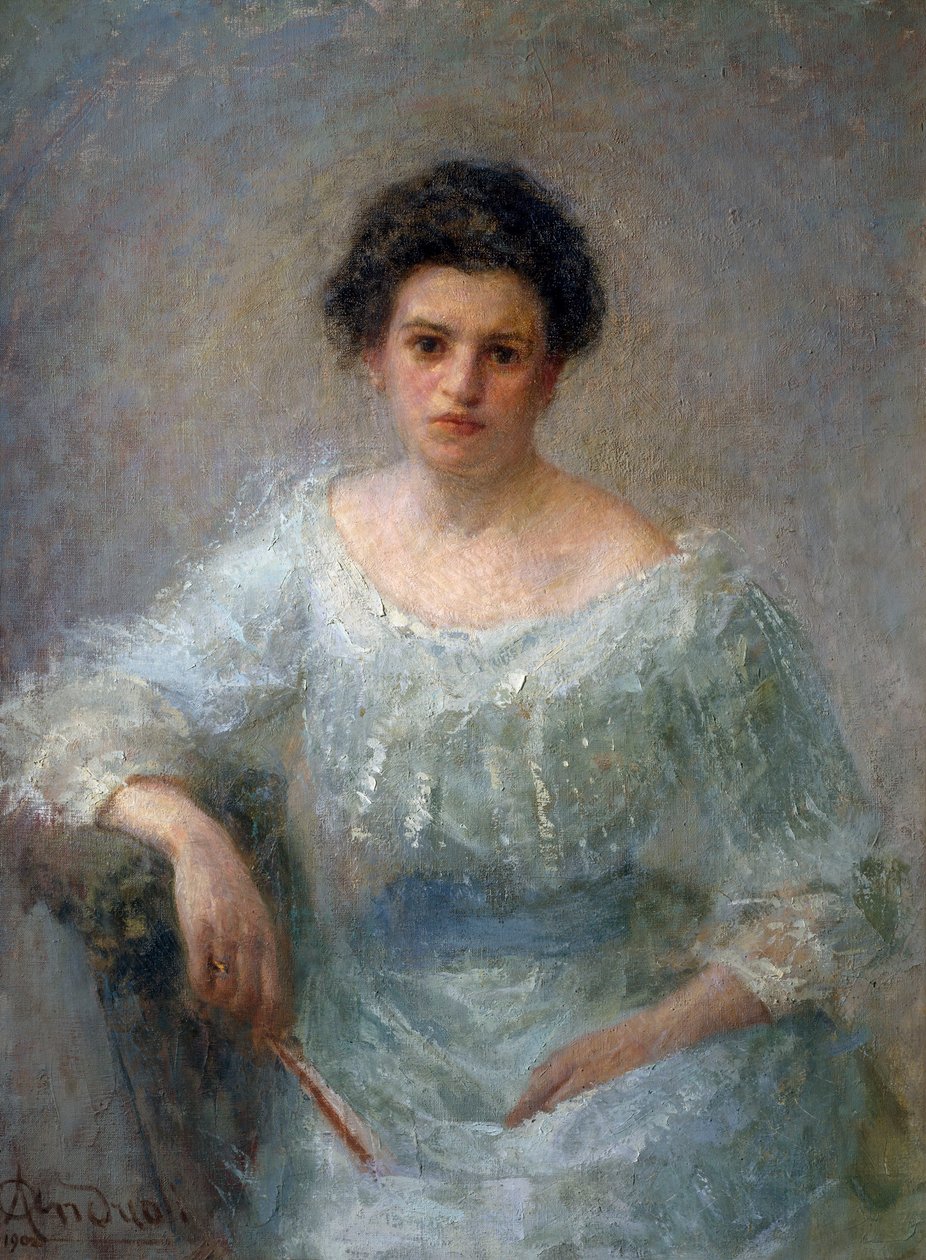
Attilio Andreoli was born on April 7, 1877, in Milan. He studied at the Accademia di Brera, where he was a pupil of Girolamo Bertini and Vincenzo Bignami. His first public success came in 1900, when his painting *Rispha che protegge i corpi dei suoi figli* won the prestigious Gavazzi Prize. During the early years of his career, Andreoli gained significant recognition for his work. In 1903, he won another award in Milan for his painting *Cristo e l’adultera*, now housed in the Galleria d’Arte Moderna in Milan. That same year, he also completed a series of mural decorations for the Church of the Friars on Via Farini. Additionally, the Galleria d’Arte Moderna in Milan received as a gift his painting *L’onomastico del Parroco*, executed in tempera and pastel. After these early successes, Andreoli shifted his focus away from biblical and historical subjects, dedicating himself to genre scenes and portraiture. His *La Violinista* won a gold medal in Milan in 1917, marking a peak in his career. He also created notable portraits, including an *Autoritratto* now in the Galleria of Piacenza, as well as portraits of benefactors at the Ospedale Maggiore in Milan. One of his later works, *Contardo Ferrini in una gloria di angeli*, painted for the Catholic University, was his final piece of significant renown. However, after 1925, interest in Andreoli’s work began to wane. Despite this, he remained an honorary member of the Accademia di Brera even after he withdrew to live in Cannobbio. He passed away in Milan on November 9, 1950. Throughout his career, Andreoli was known for his unique and meticulous technique, often using a spatula to apply paint in a way that produced solid, enamel-like color effects, without the need for finishing touches with a brush. His style adhered closely to a veristic, anecdotal approach, and he showed little interest in the broader artistic debates of his time, preferring to focus on the program of realism he had set for himself.