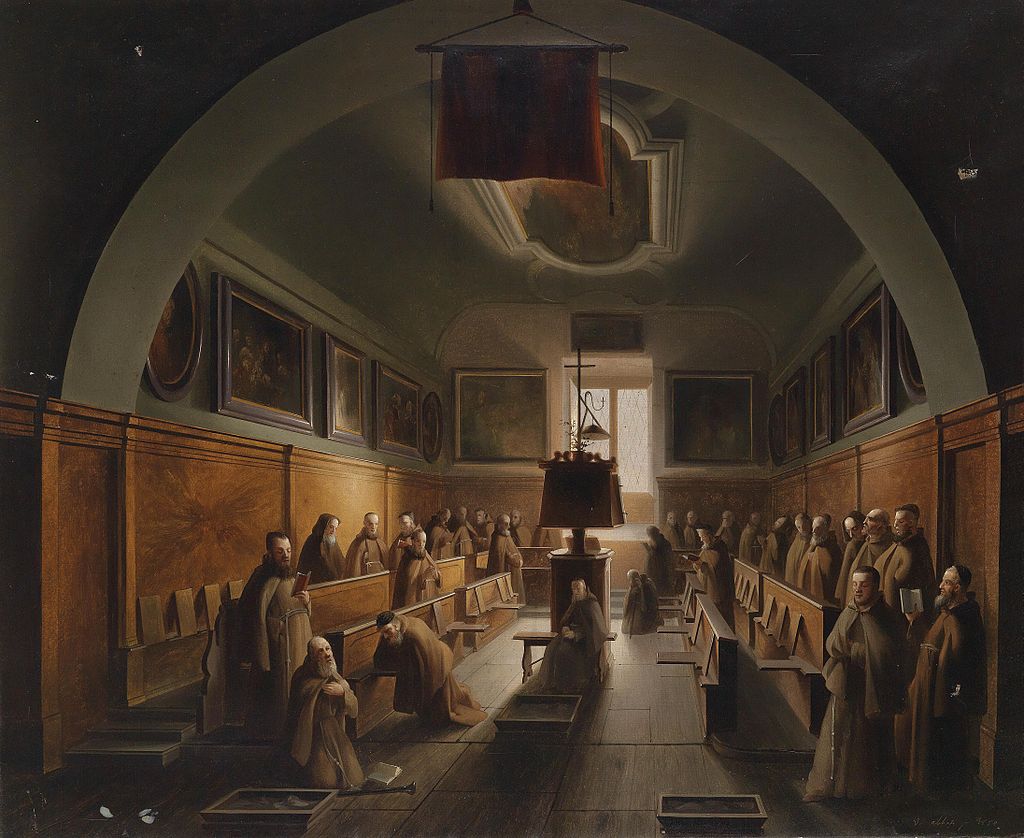
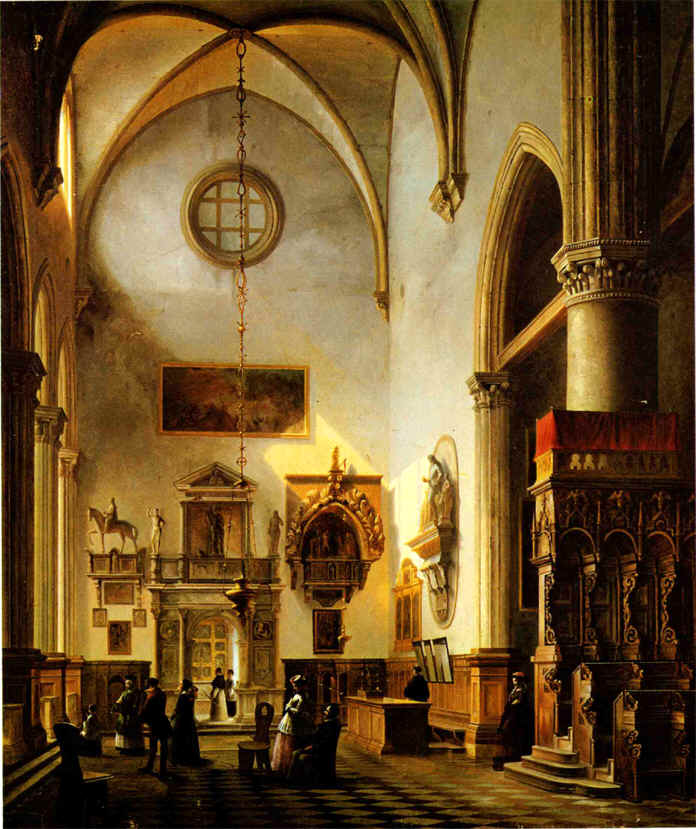
Vincenzo Abbati was born in Naples in 1803 and began his artistic training at the Royal Institute of Fine Arts in Naples, where he attended the scenography school from 1822 to 1826, studying under Niccolini. He then entered the studio of Lemasle, a scenographer at the San Carlo Theatre. From 1843, Abbati’s career took him between Graz and Florence for work-related reasons, before he settled in Venice, where he lived from 1844 to 1859. In 1861, he returned to Naples, where he was honored with the title of honorary painter at the Institute of Fine Arts. Abbati’s work was deeply influenced by his background in scenography, and he specialized in creating perspective views of interiors, particularly churches. His paintings often show a strong Dutch influence, with light playing a central role in his compositions, expertly modulated to create harmonious tonal effects. He first gained public recognition in 1826, when he exhibited a painting at the first Bourbon Exhibition. While in Venice, Abbati earned the favor of the Duchess of Berry, who made him her personal painter. The daughter of King Francesco I not only commissioned several works from him but also encouraged Abbati to participate in local exhibitions. In the 1844 Venetian exhibition, he presented, among other works, some of his most notable pieces. Through his skillful use of light and perspective, Abbati became known for his ability to create immersive and atmospheric depictions of interiors, contributing significantly to the tradition of perspective painting in Italy.