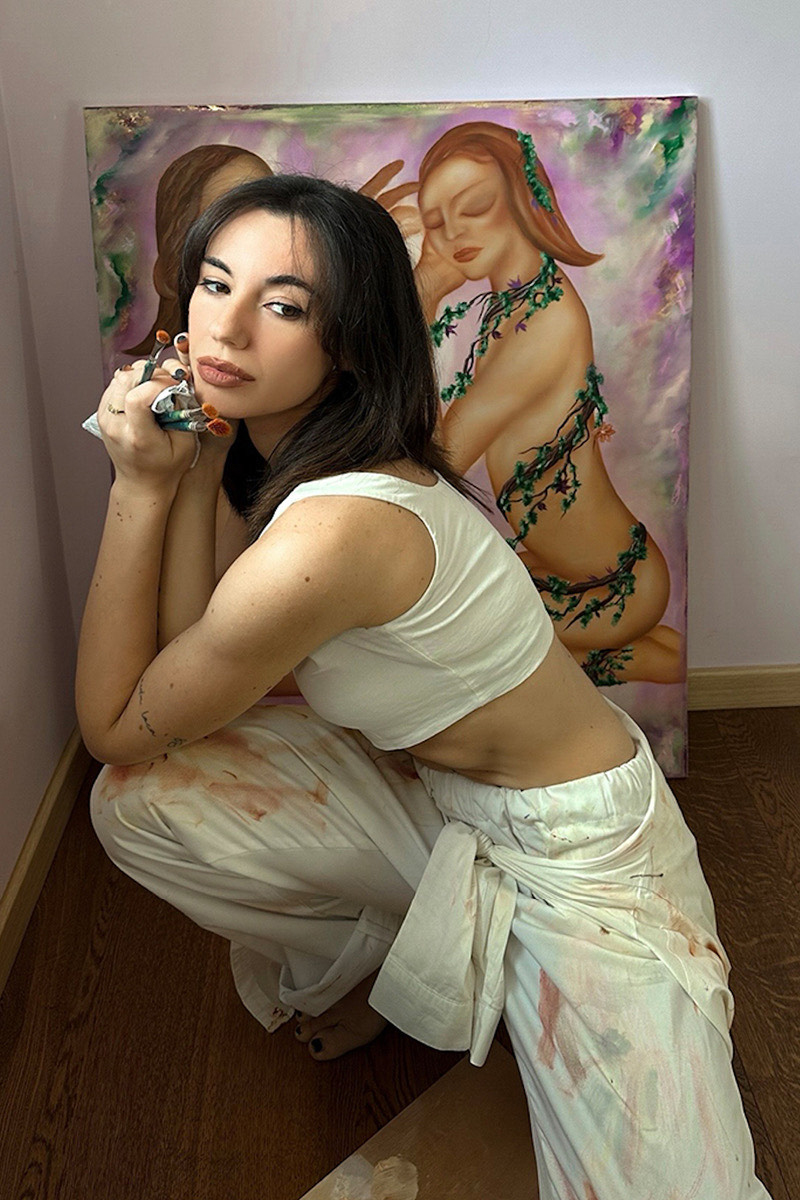
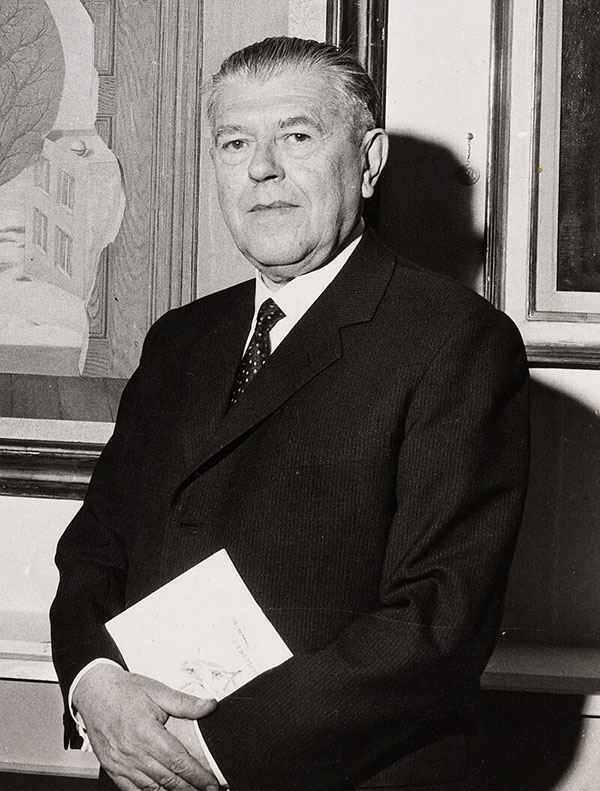
Ambra Nazifi was born on January 30, 1998, in Ronciglione, Italy. She completed her university studies at the Faculty of Architecture at Sapienza University of Rome. From the age of thirteen, she embarked on an artistic training path by attending painting and drawing courses. During these formative years, she had the opportunity to exhibit some of her works in exhibitions, thus beginning to share her artistic vision with the public. Her works are deeply interconnected and express a strong desire for rebirth, change, and the search for inner strength transformed into personal growth—therefore, an inner transformation. Through her ethnic female figures, stylistic references to Cubism emerge, combined with the use of abstract language. Natural elements are frequently employed, conveying a sense of spirituality and inner power, alongside recurring classical symbols such as veils, wings, and even the titles of her works, which reflect her classical studies. She holds a deep admiration for Frida Kahlo, an artist full of pathos, whose works powerfully convey her inner world and authenticity. For Nazifi, Kahlo represents the idea that the beauty of the soul and interiority surpasses outward appearance. Another major influence on her artistic thinking is Pablo Picasso, who redefined the role of the artist as someone capable of constructing an alternative reality—one that reveals deeper truths and transforms the creative act into a constant and free investigation. Picasso also broke through figurative conventions, opening the way to new interpretations of the human figure and space. Naturally, the study of perspective, subjects, and elements characteristic of the Italian Cinquecento has also influenced her approach to painting. She exhibited her work “Fly Away” at the Milan Art & Fashion Week and participated in the Expo of Ferrara for the 2nd Biennial of Creativity. She has taken part in several art awards, including one held at the Italian Senate. She has exhibited in various galleries, including Brera in Milan, and in Paris at the Salon d’Art Moderne & Contemporain in Saint-Germain-des-Prés, where her work was published in the magazine La Gazette des Arts. Her preferred technique is oil painting, often combined with the use of a palette knife and, in some works, gold leaf. For the artist, an artist is a different kind of person—someone with a vision unlike others. Through heightened sensitivity, she perceives reality differently and, through her works, is able to evoke emotions in the viewer. Ambra Nazifi’s painting belongs to an intimate and symbolic form of Surrealism, where the human figure becomes a means of inner transformation and identity exploration. Her works, often centered on ethnic female figures, combine Cubist references and abstract language to express the fragmentation and reconstruction of the soul. Natural and symbolic elements such as wings and veils take on a spiritual and archetypal meaning, further enhanced by the use of gold leaf, which gives the canvases an almost sacred dimension. The influence of Frida Kahlo is evident in the emotional intensity and focus on interiority, while Picasso’s legacy appears in the formal freedom and the breaking of figurative conventions. Through a material, instinctive yet conscious painterly approach, Nazifi develops a personal visual language capable of engaging the viewer in a deep emotional experience, where art becomes a tool for rebirth and self-awareness.