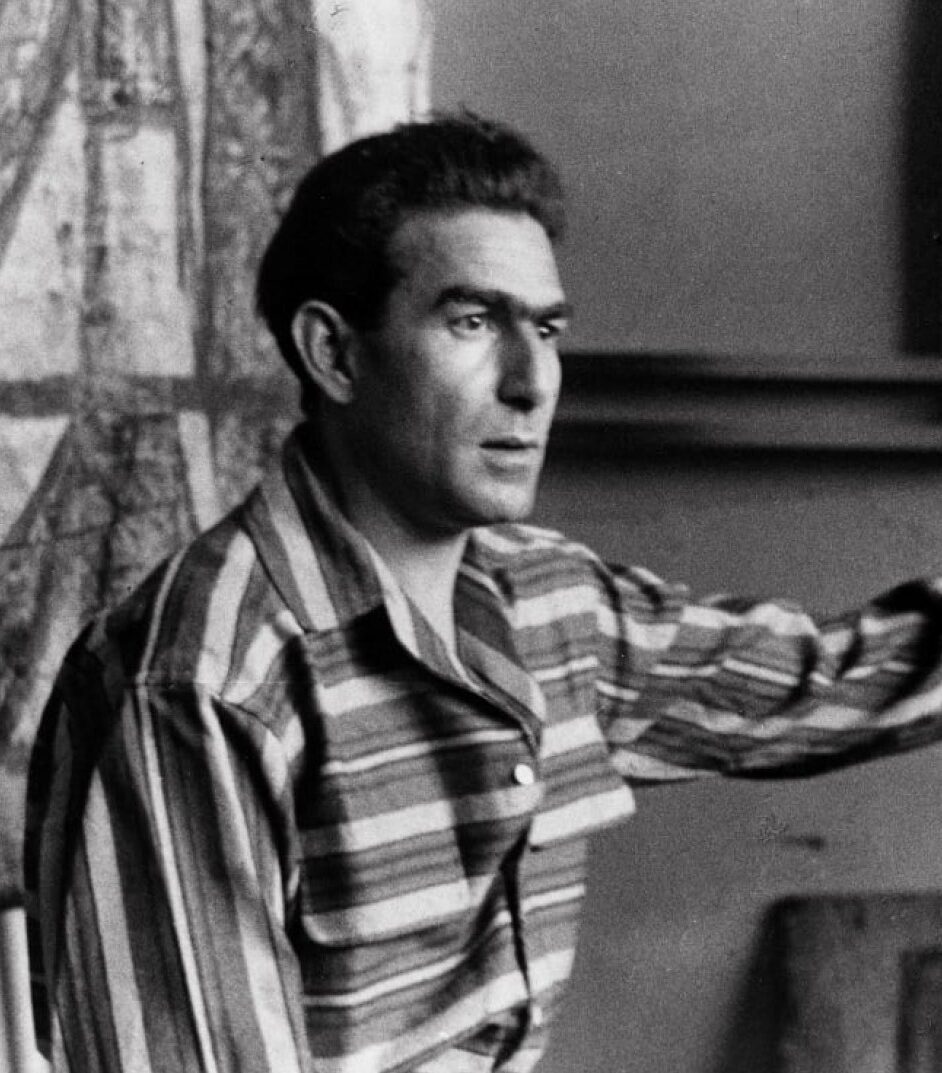
Maurits Cornelis Escher
Biography and criticism
Maurits Cornelis Escher, known as Mauk, was born on June 17, 1898, in Leeuwarden, Netherlands. His father, George Arnold Escher, was a hydraulic engineer, and his mother, Sarah Gleichman, was his second wife. From a young age, Escher developed a passion for drawing, which was further encouraged after his family moved to Arnhem in 1903. Despite a lackluster academic career and being rejected from high school, he pursued his interest in art, creating his first works, including linoleum prints. After finally passing his exams, Escher traveled to Italy, where he was deeply inspired by the masterpieces of the past. His experiences in Italy, particularly in its landscapes and architecture, greatly influenced his early works, which often explored unique perspectives. His love for Italy led him to buy a house in Frascati, where he traveled extensively on horseback between 1925 and 1935, exploring the southern regions of the country. Escher enrolled in the architecture program at the Delft University of Technology in 1918 to please his father but later switched to the School of Architecture and Decorative Arts in Haarlem. However, his passion for drawing soon overtook his architectural studies, and he pursued courses in drawing under S. Jesserun de Mesquita, whose encouragement was pivotal in his development as a graphic artist. In 1922, Escher traveled to Spain, where he was fascinated by the Alhambra’s ornate mosaics and Islamic decoration. This exposure led him to discover the technique of *periodic drawings*, characterized by the regular division of space—a theme that would become central to his later works. His fame began to grow, and by 1923, he was living in Rome, where he held his first exhibition in Siena. Escher’s works gained international recognition, with exhibitions in Switzerland and the Netherlands. In 1924, he married Jetta Umiker, a Swiss woman, and they settled in Frascati. The couple had two children, George and Arthur, and Escher’s reputation continued to rise, culminating in a third-place award for his print *Noza* at the Art Institute of Chicago in 1934. As fascism rose in Italy, Escher moved to Switzerland in 1935 due to the political climate. It was here that he produced *Hand with Reflecting Sphere*, one of his most famous prints. During this period, Escher shifted away from realistic depictions of landscapes and architecture, choosing instead to explore “inner visions.” His work took on more abstract, illusionistic qualities, incorporating complex geometric constructions and visual paradoxes. This period marked a significant shift, as he lost interest in the visible world and turned to explore themes inspired by psychology, mathematics, poetry, and science. In 1940, Escher created *Metamorphosis II*, a work that summarized much of his previous output and featured dramatic optical illusions. His exploration of ambiguity—where concepts like positive and negative, right and wrong, became interchangeable—became a hallmark of his later work. Escher returned to the Netherlands in 1941, settling in Baam with his family. He continued to produce groundbreaking works and held numerous exhibitions, while also teaching and publishing articles about his work. His use of mezzotint and regular division of space caught the attention of the global artistic community. In 1954, Escher’s work gained recognition in the scientific community through an exhibition at the Stedelijk Museum in Amsterdam, coinciding with the International Congress of Mathematicians. This connection to mathematics grew stronger over time, and in 1955, Escher was knighted by the Dutch government. In 1958, Escher published *Regular Division of the Plane* and created his first lithograph of *impossible constructions*, notably *Belvedere*. That year, the city of The Hague hosted a retrospective exhibition in honor of his 60th birthday. Despite declining health, which led to several surgeries in the early 1960s, Escher’s influence continued to grow. In 1972, he passed away in a care home for artists in Laren, Netherlands. In the decades following his death, Escher’s genius was fully recognized, culminating in the opening of the Escher Museum in The Hague in 2002. His work, known for its impossible constructions and mind-bending optical illusions, has left a lasting legacy in both the art world and the realm of mathematics.
Category of affiliation
- Painting
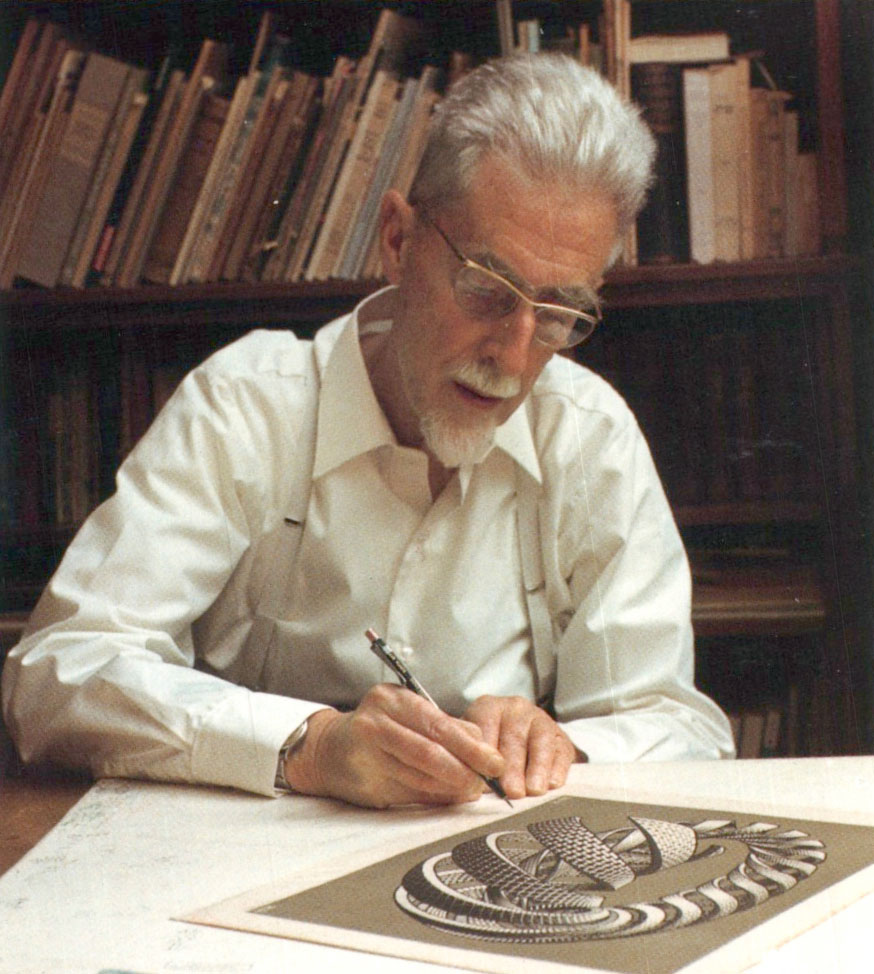
Artworks
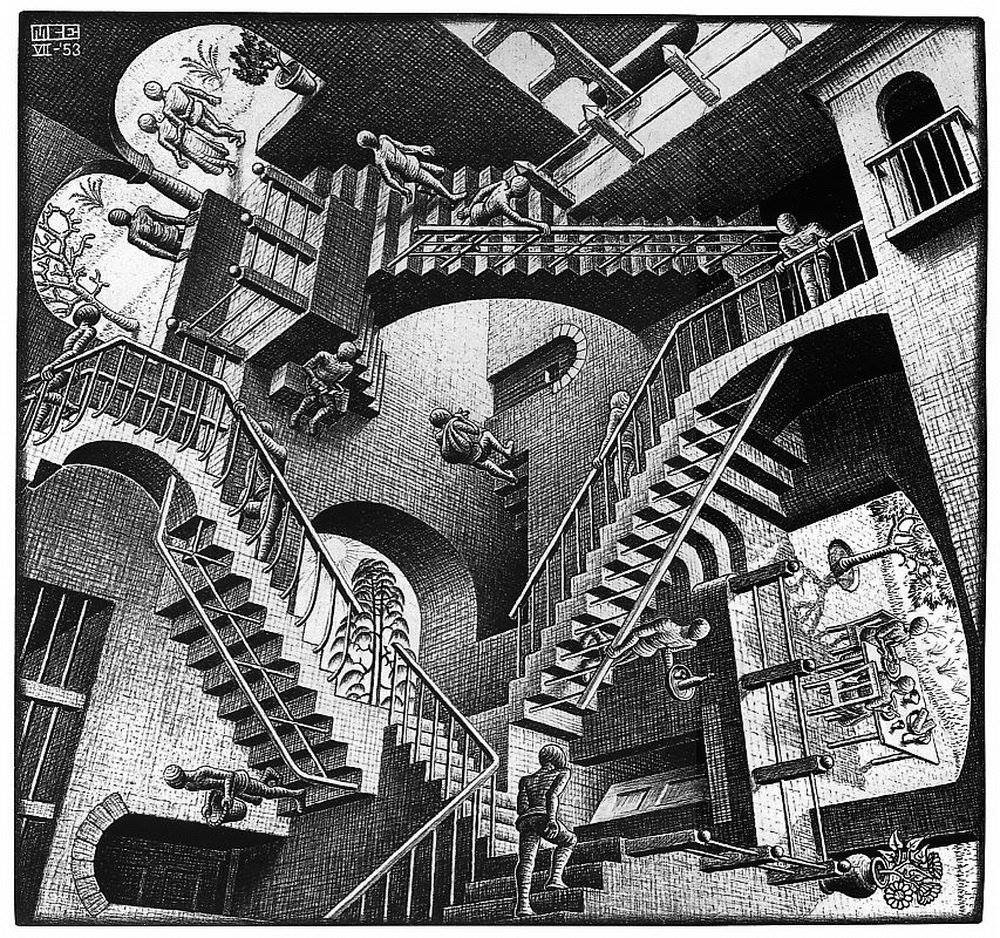
Relativity
- 1953
- Lithography
- 27.7 cm × 29.2 cm
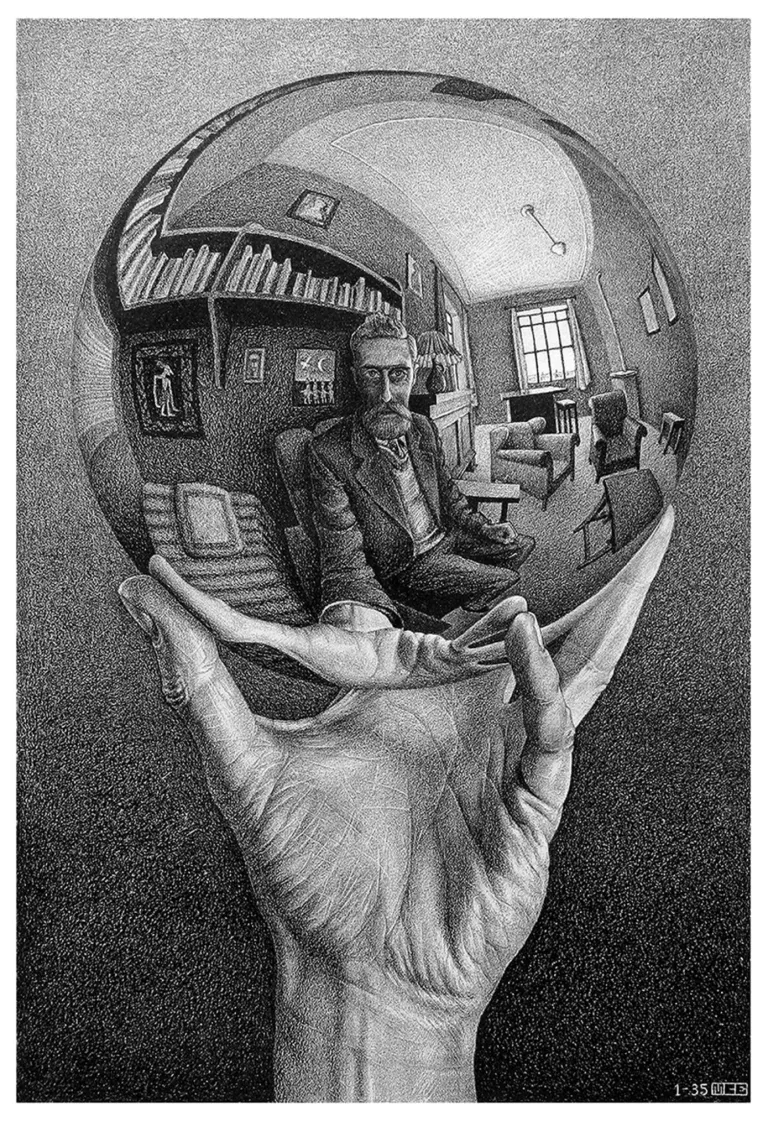
Hand with Reflecting Sphere
- 1935
- 31.8 cm × 21.3 cm
- Lithography

Draak
- 1952
- 32 cm × 24 cm
- Wood engraving