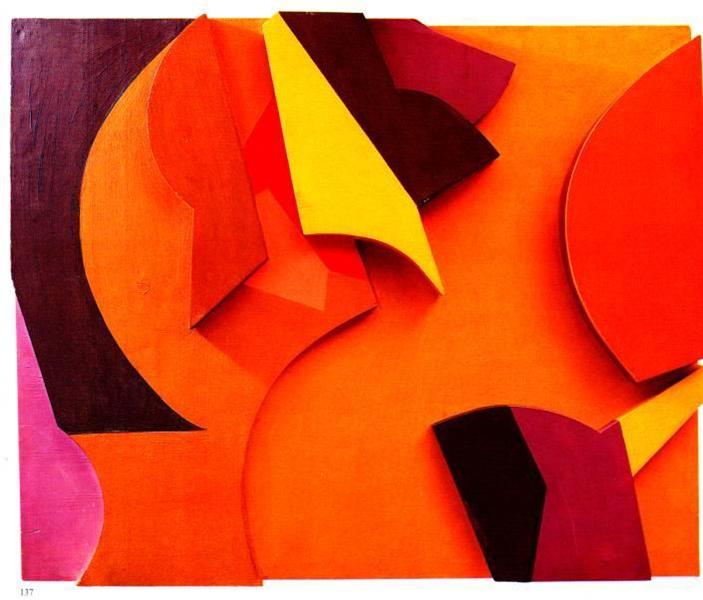
Jean Hans Arp, born in Strasbourg in 1887 to an Alsatian mother and a German father, was a pioneering artist associated with the Dada movement. His artistic training began at the École des Arts et Métiers in Strasbourg, followed by studies at the Kunstschule in Weimar between 1905 and 1907. Arp then moved to Paris, where he completed his education at the Académie Julian starting in 1908. In 1912, Arp became involved with the German Expressionist group Der Blaue Reiter, contributing to their exhibitions. However, with the outbreak of World War I, he was forced to seek refuge first in France and then in Switzerland. It was in Zurich that he became one of the founders of the Dada movement, a radical artistic and literary movement that rejected traditional culture and aesthetics. Arp was active in the Dada scenes in Zurich, Berlin, and Cologne during the war years. During this time, Arp focused on collage and the deconstruction of language, often collaborating with Sophie Taeuber, who would later become his wife. He also designed and painted sets for ballets, further exploring the intersection of art and performance. In 1925, Arp moved to Paris, where he deepened his sculptural practice and continued experimenting with new forms of expression. His work evolved from purely plastic forms to a broader exploration of innovative materials and techniques. In the 1930s, Arp distanced himself from Surrealism, choosing to focus primarily on sculpture. After World War II, Arp achieved international fame, with major retrospectives in New York and Paris showcasing his work. In the later years of his life, he devoted himself to creating large-scale public sculptures. Hans Arp passed away in Basel in 1966, leaving behind a lasting legacy as a key figure in the development of modern art.