Francesco Arata
Biography and criticism
Francesco Arata was born in Castelleone on October 21, 1890, to Maria Cattaneo and Attilio Arata. His family had Ligurian origins but moved to the Piacenza area in the mid-19th century before settling in Montodine. Perhaps due to this Piacenza connection, Arata was often referred to as “the Piacenza painter” in Milanese art reviews, a reference likely influenced by his distant cousin, the renowned architect Giulio Ulisse Arata. When Francesco was just two years old, his father died, and his mother, along with his brother Piero, moved in with her brothers in Castelleone. Arata’s childhood, as he later recalled in his memoirs published in 1982 under the title *Appunti del mio spirito*, was marked by a serene if not happy atmosphere, with no significant economic hardship. However, the early death of his father cast a long shadow over the family, a sadness that permeated their lives, evident in Arata’s writings and portraits of family members. The family’s relative financial stability allowed Francesco to attend secondary school in Soresina and, in 1908, enroll at the “Scuola Superiore d’Arte Applicata all’Industria” in Milan at the Castello Sforzesco. There, he quickly distinguished himself as a talented student, winning medals and prizes in subjects like ornamentation, composition, and perspective. In 1913, Arata joined the Academy of Brera, where he would continue his studies until 1915. During this time, he also taught at the “Scuola degli Artefici” from 1915 to 1916, under the mentorship of Cesare Tallone. This relationship had a profound impact on Arata’s technical development and his adherence to the principle of honesty in art. Tallone, a pivotal figure in early 20th-century Italian painting, influenced many students, including notable artists like Carlo Carrà and Aldo Carpi. Before enrolling at Brera, Arata worked as an assistant set designer at the prestigious Teatro alla Scala in Milan starting in 1912, an unpaid position in its first year. This job brought him into contact with prominent cultural figures such as Giacomo Puccini, Arturo Toscanini, and Umberto Giordano. These experiences, combined with his training at Brera, refined his skills in drawing, watercolor, engraving, and set design. His time at La Scala also left a lasting impact on his technical approach, especially in terms of perspective and scenographic layout, which became characteristic of his landscape paintings. In the years between 1910 and 1915, Arata also befriended architect Giovanni Greppi, who introduced him to the art of etching and watercolor. Greppi was a key influence, and Arata’s first major successes in these techniques came from exhibitions like the *Incisione Italiana* at the Palazzo della Permanente in Milan in 1915, and later, a notable participation in the *Royal Society of British Artists* exhibition in London in 1916. During World War I, Arata did not serve on the front due to the loss of an eye in his youth but contributed as a clerk in a barracks in Como. Despite this, he remained a passionate interventionist, eager to support Italy’s involvement in the war. This period was also marked by numerous sketches, particularly of soldiers and the intellectuals he met through his association with the Greppi family, which enriched his artistic vision. His travels to Rome and its surrounding countryside further influenced his work, as he sought to study the classical architecture and landscapes of the area. By the early 1920s, Arata’s focus began to shift toward painting, leaving behind the architectural pursuits that had initially engaged him. This period saw him embrace the Italian Novecento movement, which emerged as a reaction against the avant-garde and Futurist trends. The movement sought to restore classical values through a modern lens, and Arata became an integral part of this movement. He participated in various exhibitions, including the prestigious *Famiglia Artistica* show in Milan in 1921, alongside future luminaries like Giò Ponti and Cesare Fratino. While Arata remained detached from political allegiances, he shared the movement’s aesthetic goals. His works from this period, particularly his nudes and still lifes, reflect a balance between technical mastery and the softer, more contemplative aspects of “magical realism” that defined much of Italian painting at the time. His mastery of form and technique was recognized by critics, leading to personal exhibitions in Milan, Turin, and Novara, where several of his works were acquired for public collections. The 1930s marked a period of transition for Arata, both artistically and personally. He spent more time in his studio, particularly in the countryside or coastal regions, where his landscapes took on a new lightness, influenced by the post-impressionist tendencies of artists like Gino Rossi and Mario Vellani-Marchi, whom he met in Venice. These friendships led him to Burano, a place that would become crucial to his artistic evolution. His palette softened, adopting the transparent, shimmering hues of the Venetian lagoon, and he found new inspiration in its landscapes. Although the onset of World War II brought financial pressures and domestic responsibilities, Arata remained productive, frequently returning to his beloved countryside for inspiration. By then, he had settled into a more conventional painting style, producing works that were more accessible to his clientele, though still technically proficient and emotionally resonant. During these years, he also took on the task of designing the new municipal building in Castelleone, a project that, despite personal and professional challenges, would become his lasting architectural legacy. In the later years of his life, Arata married Enrica and had four children. This period saw him take on a more domestic role, balancing his artistic output with the demands of family life. His involvement in Milan’s *Bagutta* circle, a group of intellectuals and artists, helped to maintain his connection with the broader cultural scene. His work continued to evolve, though he often found solace in the simplicity of rural life, as evidenced by his numerous portraits of local women and nature still lifes. Despite the hardships of the war years, Arata’s reputation as a respected artist remained strong, and his later works continued to reflect the artistic maturity he had developed throughout his career. Francesco Arata’s life and work epitomize the blend of rigorous academic training, deep intellectual engagement with contemporary artistic movements, and a profound connection to the landscapes and people of his native Lombardy. His work remains a significant contribution to the Italian figurative tradition, particularly within the Novecento movement, with a legacy that transcends his time.
Category of affiliation
- Painting

Artworks
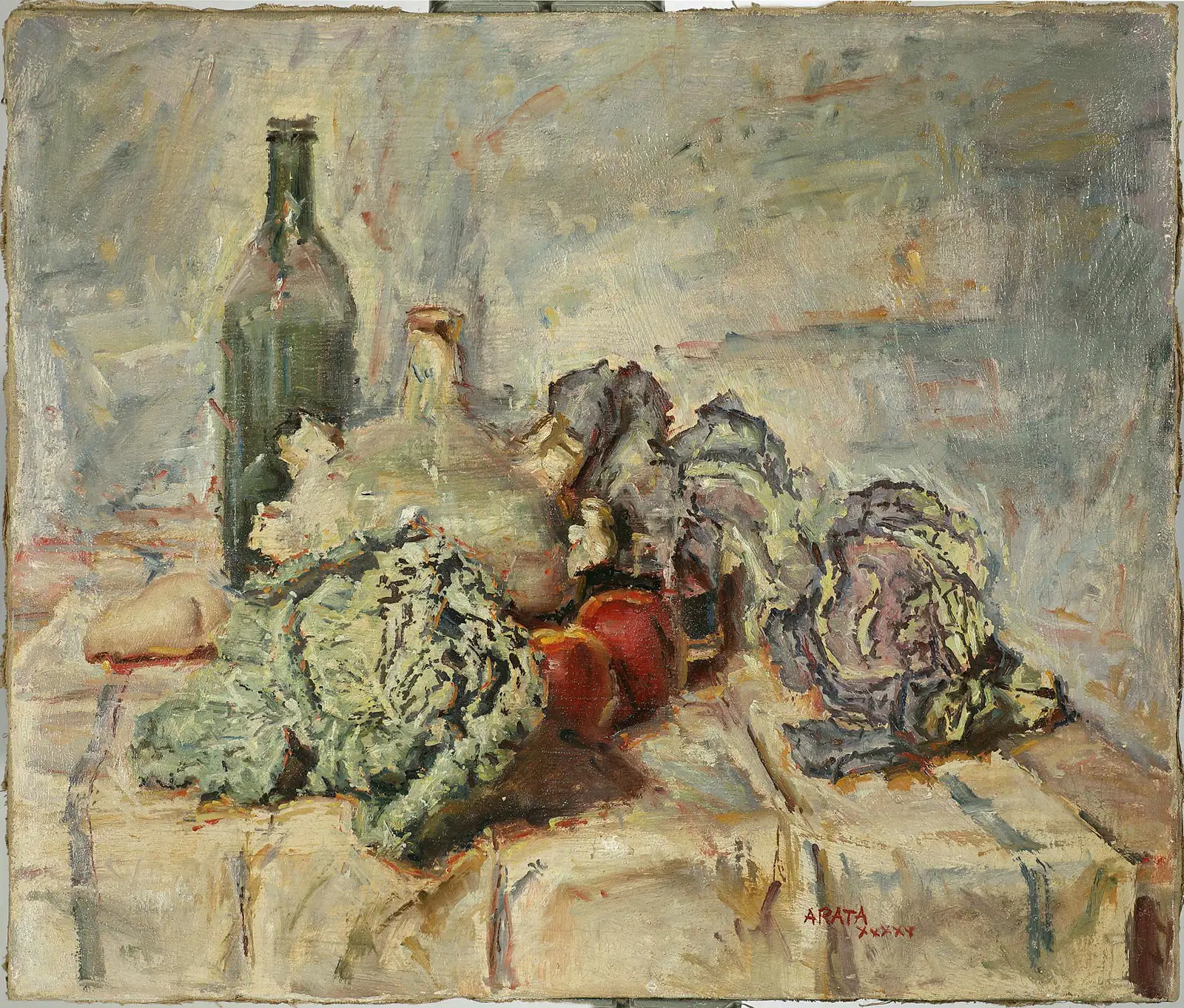
Still Life with Savoy Cabbage
- 1945
- 60 cm x 70 cm
- Oil on canvas
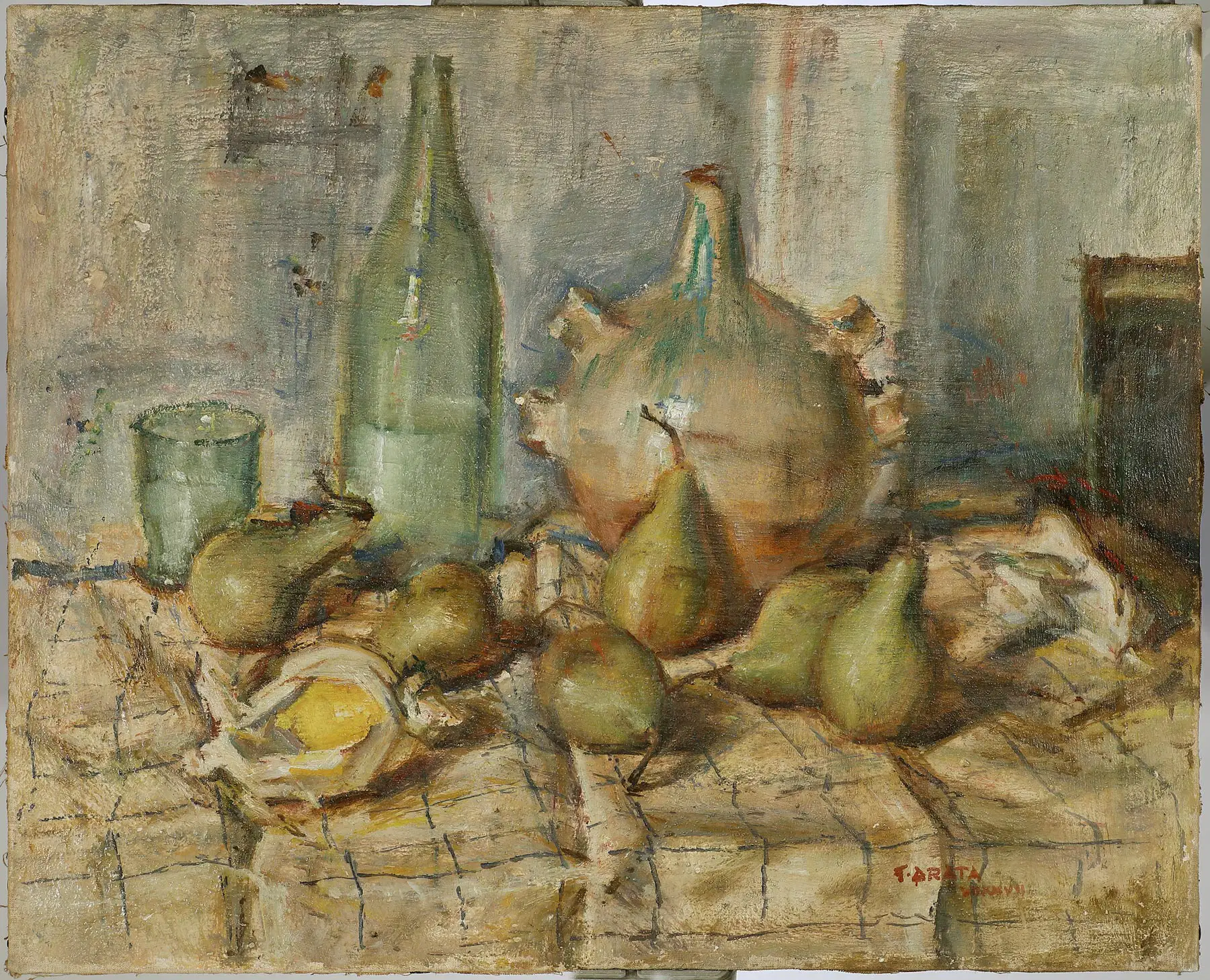
Still Life with Pears, Bottle and Pitcher
- 1947
- 65 cm x 80 cm
- Oil on canvas
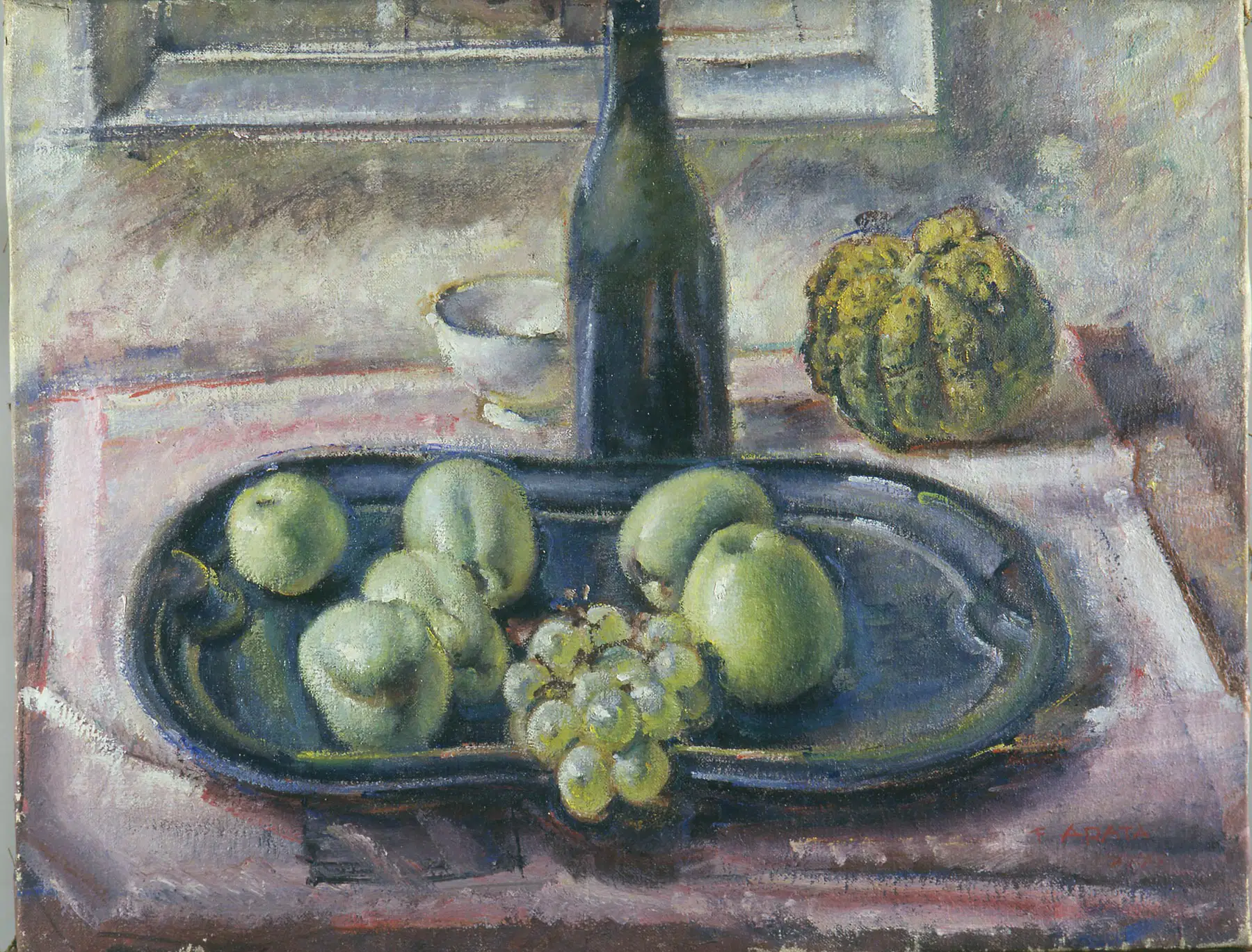
Still Life
- 1935
- 55 cm x 70 cm
- Oil on canvas