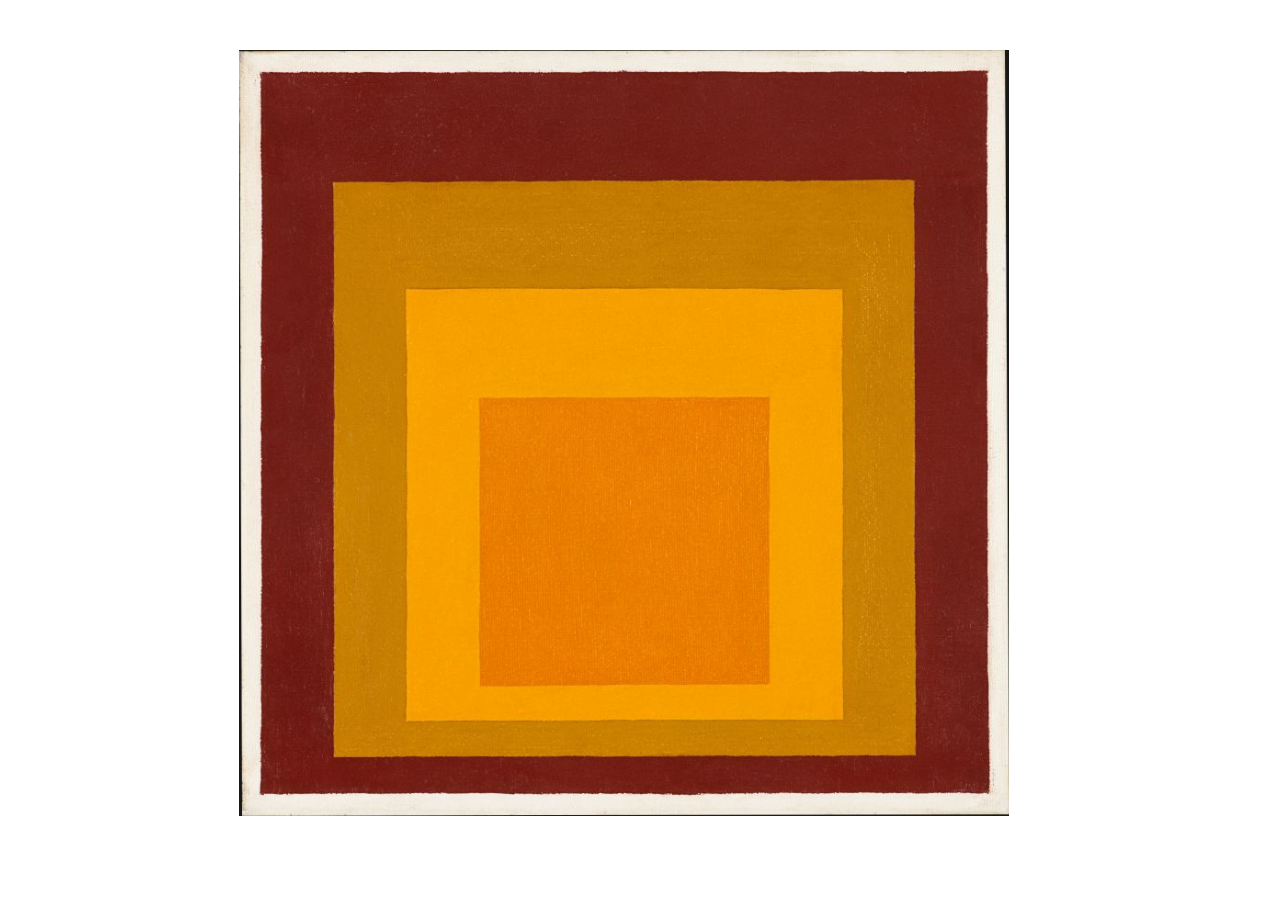
Josef Albers was born on March 19, 1888, in Bottrop, Germany, and his early education in painting took him across various cities in Germany, including Berlin, Essen, and Munich. However, it was in 1920, when he joined the Bauhaus in Weimar, that his artistic journey truly began to take shape. By 1925, when the Bauhaus moved to Dessau, Albers had already established himself as a key figure in the school, becoming a professor and continuing to develop his distinct approach to art. At the Bauhaus, Albers became fascinated with how form and color could influence perception. Rather than embracing the traditional static approach to painting, he sought to destabilize it. His work from this period often revolved around repeating geometric patterns, using primary colors to explore how they interacted with light and space. His creations weren’t limited to paintings; he also ventured into printmaking, metalwork, furniture design, and most notably, colored glass collages that played with the changing light around them. However, the rise of the Nazi regime in the early 1930s forced the Bauhaus to shut its doors. Albers, like many of his peers, was forced to leave Germany. In 1933, he moved to the United States, eventually becoming a citizen in 1939. There, he settled in North Carolina, where he taught until 1949, before relocating to New Haven, Connecticut. It was at Yale University that he truly cemented his influence as a teacher, mentoring some of the most important artists of the 20th century, including Robert Rauschenberg, Eva Hesse, and Richard Anuszkiewicz, among others. While his teaching career flourished, Albers continued to evolve as an artist, most famously with his series “Homage to the Square,” which he began in 1949. This series featured squares of overlapping colors, creating visual illusions of depth and movement that encouraged viewers to rethink how they perceived space, color, and light. Through these works, Albers explored how our perceptions of color and form could shift based on context, light, and placement, a concept that laid the foundation for much of the Op Art movement that would follow. Beyond his artistic practice, Albers was a passionate theorist. He wrote extensively about color, aiming to uncover the underlying logic and psychology of color relationships. His ideas on color theory, which were rooted in his rigorous academic training and practical experimentation, became central to many contemporary art movements, influencing generations of artists and designers. His collaboration with Italian artists, including Getulio Alviani, further solidified his connection to the evolving field of optical art. Throughout his life, Albers remained deeply involved with his work and the artistic community. Alongside his wife, Anni Albers, a renowned textile artist, he continued to teach, write, and create until his death in New Haven on March 26, 1976. His legacy endures not only through his own works but also through the countless artists he inspired and the profound influence his color theories have had on the visual arts.