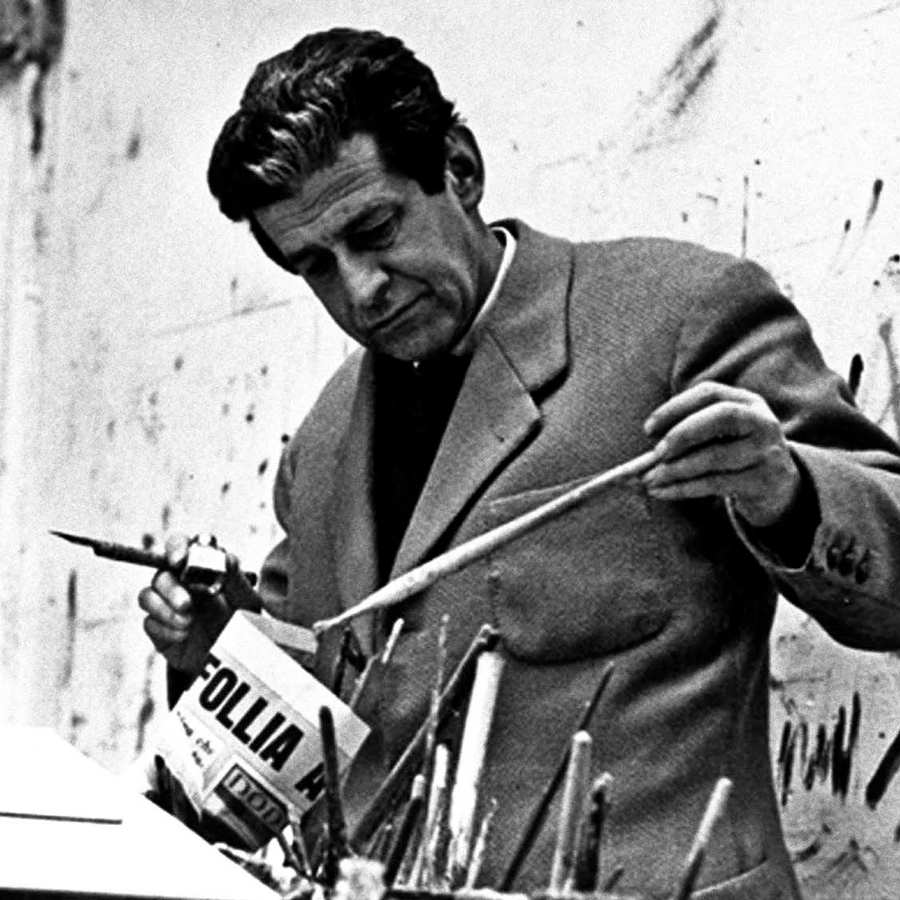
Giulio Turcato was born in Mantua on March 16, 1912. He moved to Venice in 1920, where he attended the Ginnasio, the School of Art, the Liceo Artistico, and the Free School of Nudes. His early works, including landscapes and still lifes, date back to 1926, with his first group exhibition in 1932. Between 1934 and 1936, Turcato worked in Venice in the studio of architect Breddo and participated in exhibitions in Florence and Venice. He later moved to Palermo for officer training during World War II and, in 1937, settled in Milan where he worked as a designer and mosaicist in architect Mauzio’s studio. That year, he held his first solo exhibition. In 1940, Turcato exhibited at the Galleria Grande in Milan. The following year, he traveled to Rome for a brief recovery after an illness. Between 1942-43, he was back in Venice, teaching drawing at the Portogruaro professional school and showcasing his work at the XXIII Venice Biennale, marking the first of many participations in the event. Turcato permanently moved to Rome in 1943, where he presented a still life at the IV Quadriennale. He participated in group exhibitions at the Zodiaco gallery and began his association with artists like Scialoja, Vedova, and Leoncillo. In 1945, he co-founded the Art Club and became involved in the Free Association of Figurative Arts. He participated in group shows and had a solo exhibition with Angelo Savelli at the Galleria San Marco in Rome. In 1947, Turcato co-founded the Forma group with Dorazio, Guerrini, Perilli, and others, which was supported by the magazine Forma 1. He participated in numerous exhibitions, including the Fronte Nuovo delle Arti and his personal exhibitions in Rome. The year 1948 saw him in Milan and Venice, meeting artists like Dova, Fontana, and Munari, and organizing the Arte Astratta in Italia exhibition. He also participated in Arte Oggi in Florence and was invited to the XXIV Venice Biennale. Throughout the late 1940s and early 1950s, Turcato exhibited extensively, both in Italy and internationally. In 1951, he joined the group Gli Otto, which included Afro, Birolli, Corpora, and Vedova. His work was displayed at major exhibitions, including the XXV Venice Biennale, where he won an acquisition award for his painting Miniera. His participation in numerous group shows, such as the International Exhibition of Contemporary Painting at the Carnegie Institute in Pittsburgh (1955), cemented his international reputation. Turcato’s career flourished through the 1950s and 1960s with solo and group exhibitions at prestigious venues such as the Guggenheim International Award, Documenta II in Kassel (1959), and various Biennales in Venice. In 1960, he became a member of the Gruppo Continuità and began exploring new themes and materials in his work, including the Tranquillanti series. By the 1970s, his art was recognized for its unique vision within the informal abstract movement, which he continued to develop with increasingly poetic and visionary abstraction. In the later stages of his career, Turcato held numerous retrospectives and personal exhibitions, including at the Museum of Modern Art in Bucharest (1979), the Musée de l’Athenée in Geneva (1980), and the Galleria Nazionale d’Arte Moderna in Rome (1986). His final exhibition took place in 1989 at Sperone in New York, showcasing works like Ipnotico and Blu. Giulio Turcato passed away in Rome on January 22, 1995.