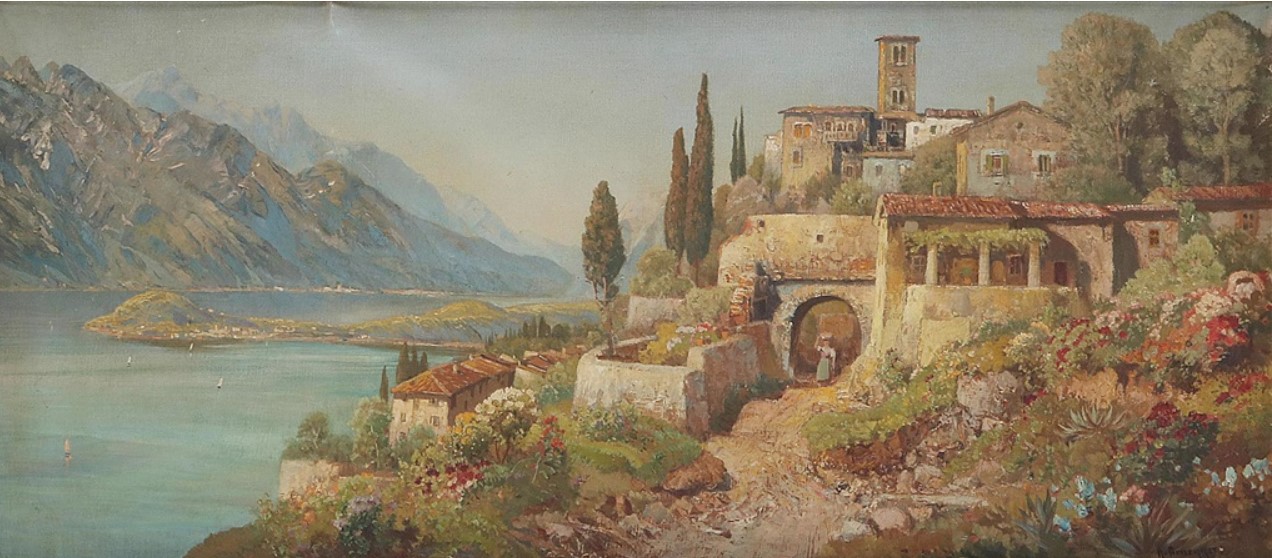
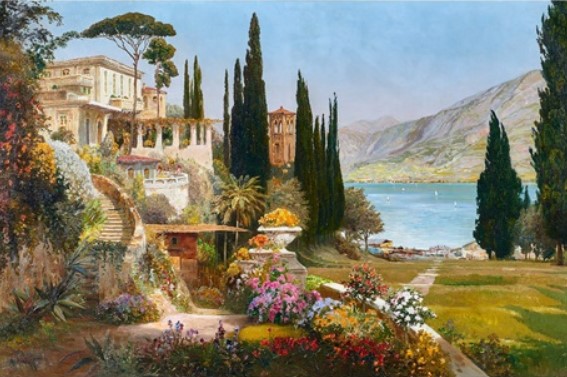
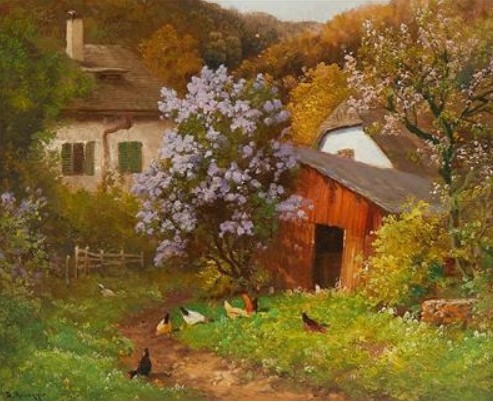
Alois Arnegger, born in Vienna on March 9, 1879, was an Austrian painter renowned for his depictions of snowy landscapes, coastal scenes from places like Naples, Capri, and Sorrento, as well as various Italian vistas. He honed his artistic skills at the Academy of Fine Arts in Vienna, studying under Robert Russ, a specialist in landscape painting, and August Eisenmenger, a historical artist. His artistic journey took a significant turn when he traveled to Italy in 1920, where he became captivated by the Mediterranean coastal landscapes. This experience left a lasting impression, and upon his return to Austria, he began to create stunning alpine scenes. Arnegger’s art was distinguished by dramatic lighting and vivid portrayals of nature, especially in his Alpine works, which earned him admiration from collectors. He passed away in Vienna on August 11, 1963. His son, Gottfried Arnegger, also followed in his footsteps as a painter. Alois Arnegger’s work primarily focused on landscapes, particularly rural scenes from his homeland of Vienna. His later works turned to the dry, rugged coastlines of Italy, where he portrayed the stark beauty of the Mediterranean environment. His landscapes were often marked by intense and dramatic lighting, which became a signature feature of his style. The Alpine scenes, in particular, gained considerable recognition and became some of his most celebrated works. Arnegger was influenced by the Pre-Impressionists, a movement that played a key role in setting the stage for the rise of Impressionism. The Pre-Impressionists were known for their advanced technical skills, which allowed them to create surfaces that were smooth and free of visible brushstrokes. Their works often featured idealized human figures, typically depicting divine or mythological subjects, and were often large in scale with soft, muted color palettes. These influences can be seen in Arnegger’s own meticulous technique and his focus on capturing the idealized beauty of nature. In terms of artistic movements, Arnegger is most closely associated with Romanticism, a style in which artists emphasized the sublime aspects of nature, often depicting landscapes or scenes painted outdoors. Romantic works are typically characterized by their focus on the sky, landscapes, and atmospheric conditions, as well as a deep emotional connection to the subject matter. Arnegger’s style, particularly his use of dramatic lighting and his keen observation of natural environments, aligns well with the principles of Romanticism, with elements of Pre-Impressionism also contributing to his unique approach.