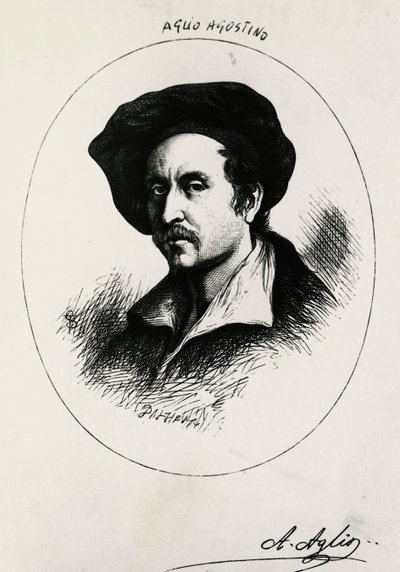
Agostino Aglio (born December 15, 1777, in Cremona, Italy) was an Italian painter, lithographer, and decorator who spent much of his career in England. He was the son of Gaetano Aglio, a notary, and Anna Maria Mondoni. He began his artistic education in Milan, studying under G. Albertolli at the Accademia di Brera. In 1798, Aglio volunteered for the Cisalpine Republic’s army, fighting in several battles in Italy. After a period of illness, he moved to Rome in late 1799, where he met the English architect William Wilkins. Together, they embarked on an extended journey through Egypt and Greece, from which Aglio made sketches and drawings of the monuments, contributing to Wilkins’ project The Magna Grecia. Upon his return to Rome in 1803, Aglio moved to England at Wilkins’ invitation in 1803. There, he briefly served as an assistant in drawing at Caius College, Cambridge. By 1804, he moved to London, where he became a well-regarded private art instructor to the upper class. In 1805, he married Letizia Clarke. Aglio worked on several large-scale decorative projects in London, including work in the Opera House (which was destroyed by fire in 1808) and the Drury Lane Theatre (which also burned down in 1809). He went on to create frescoes in various locations, including Woolley Hall in Yorkshire (1807-08), the Pantheon in Oxford Street (1811), and St. Mary Moorfields Church (around 1817), a strikingly large fresco of the Calvary. Aglio’s career was also marked by his contributions to lithography, which he helped popularize in England. He produced lithographs based on his travels and artistic projects, including works on the interior and temporary decorations at Woolley Hall (1821), and various landscape studies, including a series on trees and forest scenery (1837). In the 1820s, Aglio worked on a commission to reproduce Aztec manuscripts for Lord Kingsborough, resulting in nine volumes of The Antiquities of Mexico (1830-48), with a thousand of his color lithographs. His other notable works included decorating the Old Town Hall in Manchester (1831-34), the Catholic Chapel in Duncan Terrace (1837), and several churches in Reading and Leeds. He also contributed to the decoration of the Olympic Theatre in London in 1849. Throughout his career, Aglio continued to exhibit his works at the Royal Academy and other venues. In 1846, he painted a Pompeian pavilion at Buckingham Palace, which was later destroyed. Aglio died in London on January 30, 1857. He left behind an autobiography written between 1852 and 1856, which was later used as a source for much of the information about his life. His son, also named Agostino, followed in his father’s artistic footsteps as a watercolorist and sculptor.