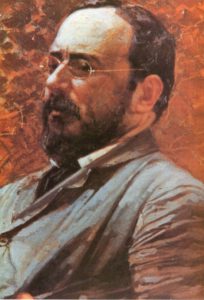
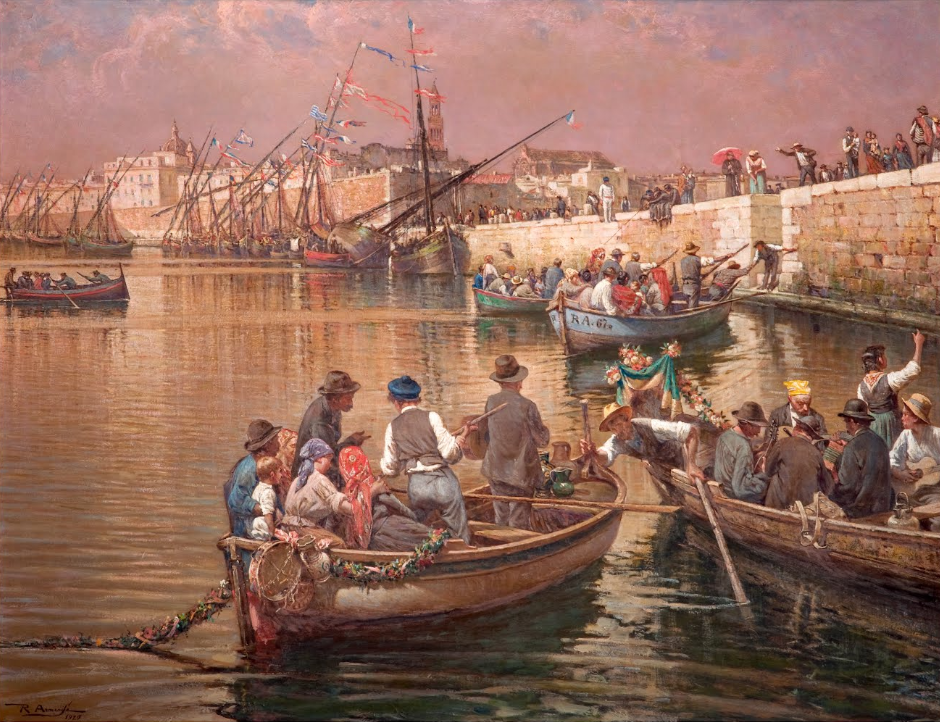
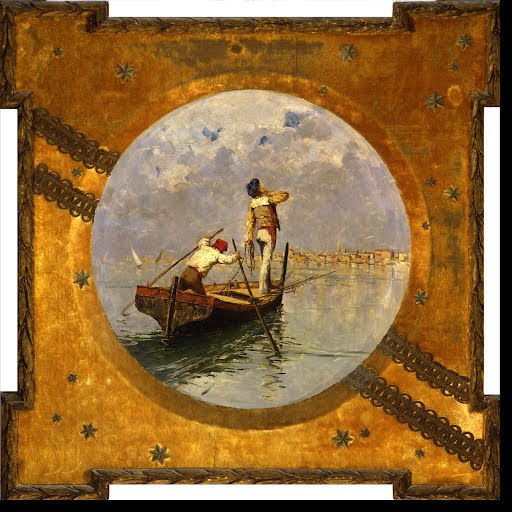
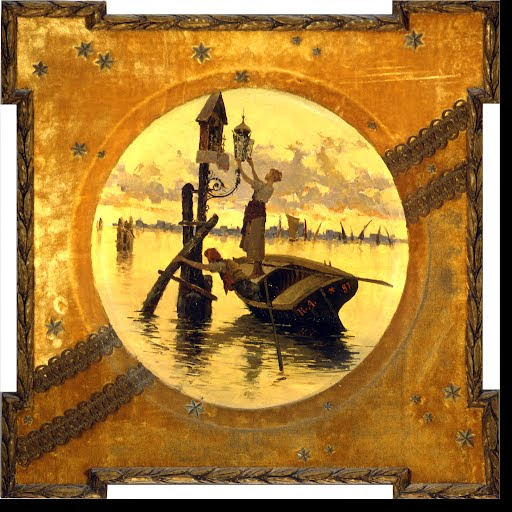
Raffaele Armenise was born in Bari on March 20, 1852. After winning a scholarship of 60 lire per month, he moved to Naples to study under G. Ruo and D. Morelli. Around 1875, he opened a studio in Capodimonte, where he quickly gained success with works such as “The Marshal d’Ancre,” “The Jewish Usurer,” “The Vatican,” “The Costly Price,” and “The Libertines,” which was exhibited in Turin in 1880. Among his public works, the most notable are the paintings for the dome of the Petruzzelli Theater in Bari, including “The Tournament,” “The Bullfight,” “The Circus,” and “The Chariot of Thespis,” as well as the related curtain. In 1881, he married the daughter of the oleographer Borsino and the painter Leopoldina Zanetti and moved to Milan, where he contributed numerous oleographs to his father-in-law’s workshop. During his time in Lombardy, he created works such as “The Visit to the Cardinal Uncle” (now at the Revoltella Museum in Trieste), “The Family of the Blind Man,” “Childhood” (at the Mitchell Museum in New Orleans), “Fishing,” and “Faith” (at the Museum of San Gallo), as well as a “Portrait of Giuseppe Verdi” and “The Honor of the Guest.” Armenise also contributed pen drawings to periodicals of the time and, as an expert lithographer, was a regular collaborator with *Illustrazione Italiana*. He decorated the Bernasconi villa in Mendrisio with frescoes and won a gold medal from the Ministry of Public Education for his work “A Rich Baptism.” Although he was a skilled painter, a quick and talented draftsman, and a born illustrator, his fame, largely based on anecdotal themes, faded over time, surviving only for a limited period. He died in Milan on January 14, 1925.