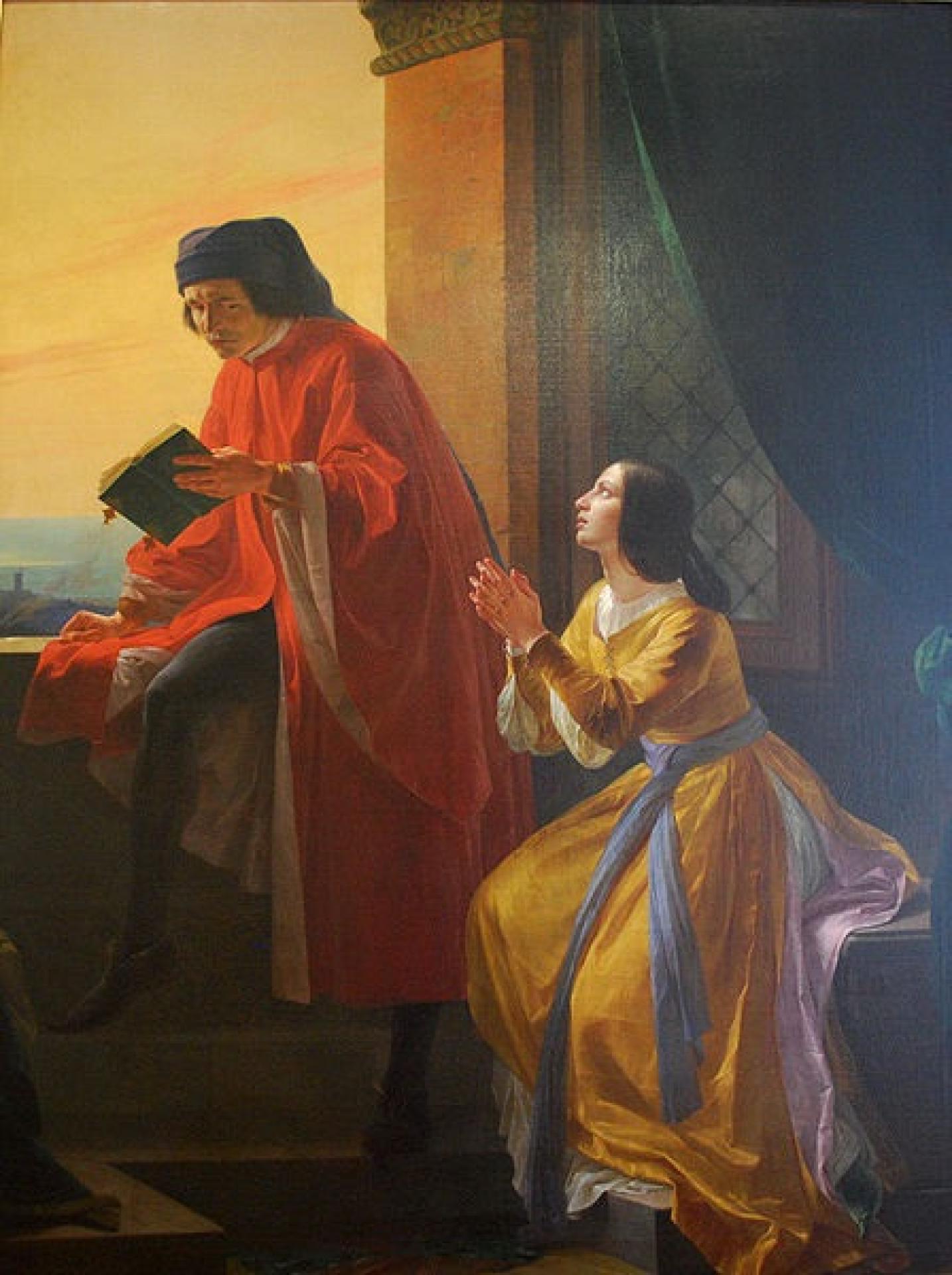
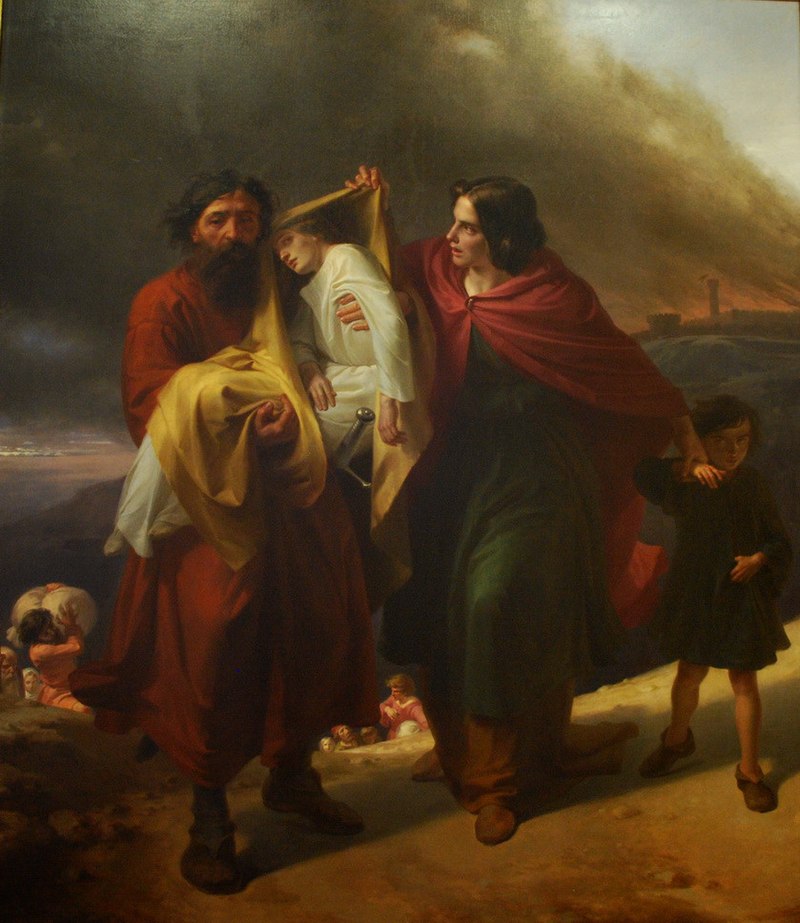
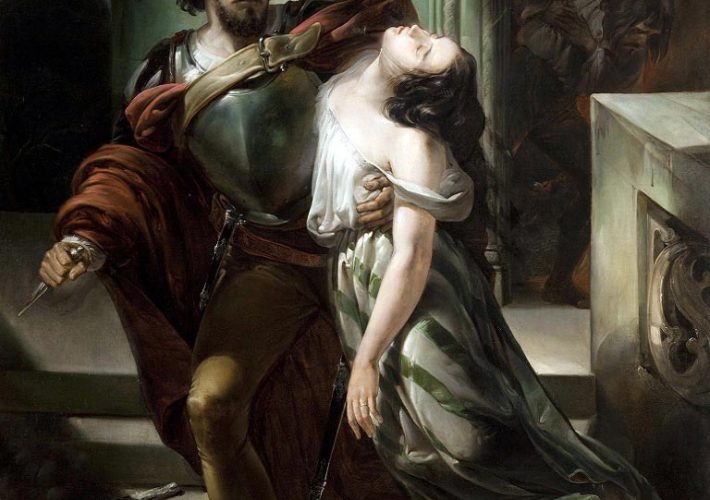
Carlo Arienti was born on July 21, 1801, in Arcore, the son of Bernardo, the director of the botanical gardens in Mantua. As a child, he was largely self-taught, copying the frescoes of the Palazzo Ducale and Palazzo del Te in Mantua, where he had free access. Orphaned at thirteen, he moved to Milan, where he studied at the Brera Academy under L. Sabatelli and C. Pacetti, surviving on a modest pension and income from the many drawings he sold to art dealers and entrepreneurs. With the support of a patron, Arienti refined his skills in Rome from 1824 to 1828. Upon returning to Milan, he gained recognition in 1831 for his portrait of composer Vincenzo Bellini, which remains his only surviving work painted from life. During this period, he painted several notable works, including *La donna greca* (1833), which he sold to the governor Count Harbing, *The Killing of Giovan Maria Visconti* for Prince Belgioioso, and *The Massacre of the Innocents* for Emperor Ferdinand I of Austria in 1835. Arienti also succeeded Sabatelli as a professor at the Brera Academy for three years while Sabatelli was away in Florence. In 1838, he painted a series of battle scenes depicting the House of Austria for the Salone delle Cariatidi in the Royal Palace of Milan to commemorate the visit of the Austrian Emperor. In 1840, he painted a portrait of Amedeo VIII for the Royal Palace of Turin, and in 1843, he was invited to take the chair of painting at the Albertina Academy in Turin, where he remained until 1859. During these years, he completed the famous *Expulsion of Barbarossa* (1845), in which he depicted himself as Galiano Aulari, wearing a red hat. This self-portrait led to suspicions from the political police, possibly explaining his later focus on religious themes, such as *Angels of the Calvary* (1846), *Persecution of the Christians* (1848), and *Prophet Jeremiah* (1856). Despite his success, Arienti’s relationship with the director of the Academy, Marchese di Breme, soured, leading him to leave Turin. In 1859, during the annexation, he accepted an offer to become the director of the newly re-established Academy of Fine Arts in Bologna. There, he completed works such as *The Origin of the Lombard League* for the royal villa of Santa Maria in Bosco and a portrait of King Vittorio Emanuele II. His time in Bologna was marked by conflict with local artistic circles and the academic community, but he found support from friends like the poet Mercantini and biographer Masini, as well as admirers such as Giuseppe Mazzini. In 1869, Arienti suffered a stroke and passed away on March 21, 1873. His self-portrait is housed in the Uffizi Gallery. His work combines neoclassical education and romantic elements, reflected in both his choice of subjects and his illustrative style, though without radical changes in technique or interpretation.