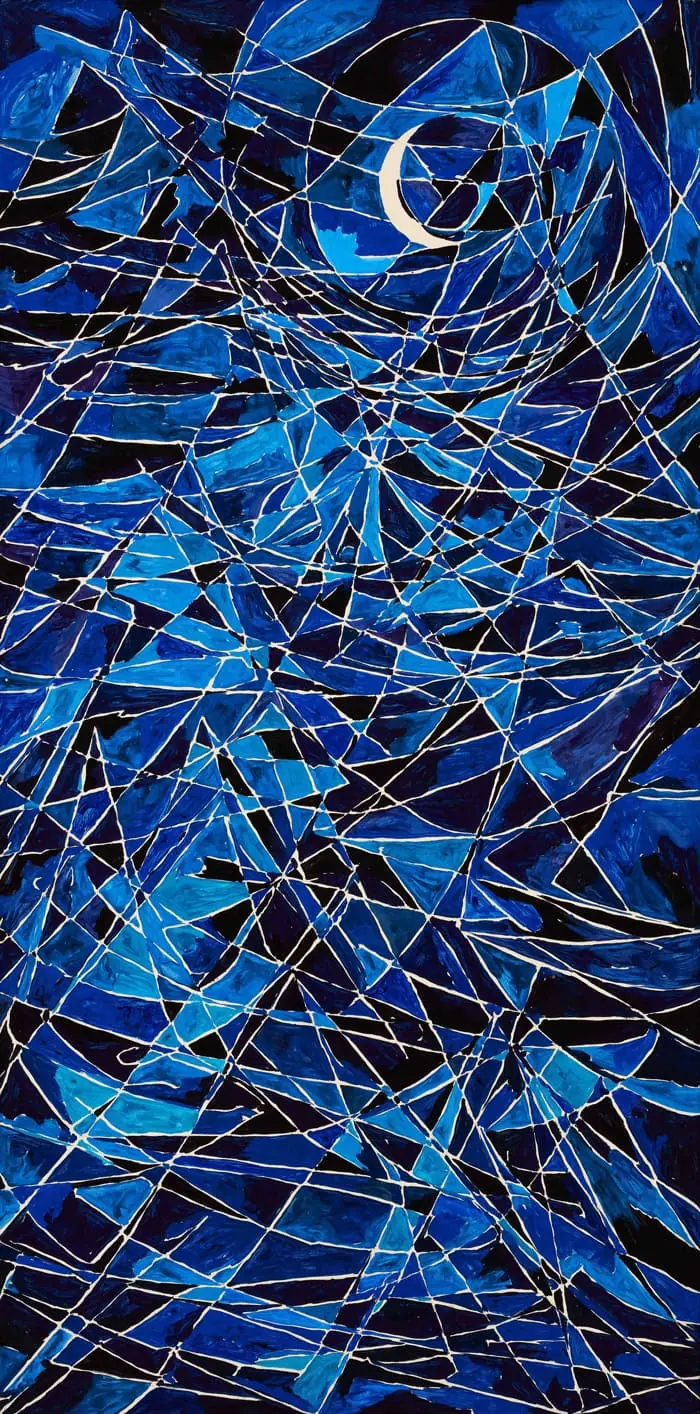
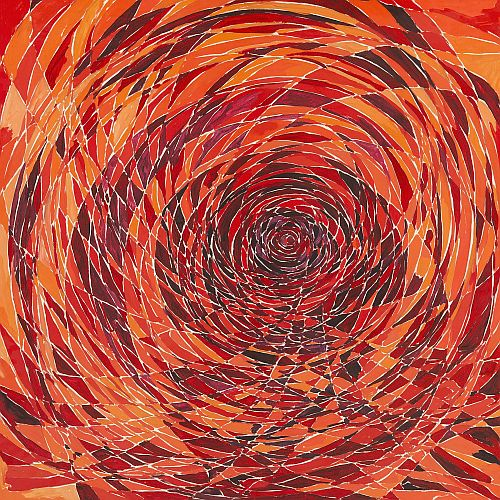
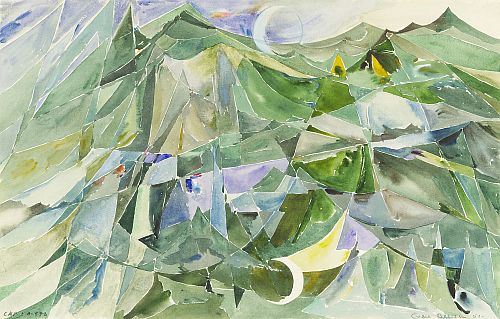
Else Alfelt was born on September 16, 1910, in Copenhagen, Denmark, and had a difficult childhood, spending ages 7 to 15 in an orphanage after her parents’ divorce. At the age of 12, she began painting, creating portraits of children and staff at the orphanage with materials from a paint set given to her by her aunt. After studying at a technical school, she was rejected by the Academy of Fine Arts in Copenhagen and failed to enter art exhibitions until 1936, when two of her naturalistic portraits were finally accepted. In 1933, she met Carl-Henning Pedersen, whom she married, and they had two daughters. Their meeting was pivotal both personally and artistically, leading to a strong creative collaboration. In the 1930s, Alfelt joined various avant-garde movements, including Linien, Høst, Skandinaverne, and Helhesten, the Danish precursor to the international CoBrA movement. Her art shifted toward abstraction, influenced by the political and social climate of the time. She participated in international exhibitions and collaborated with other experimental artists such as Asger Jorn and Richard Mortensen. During the 1940s and 1950s, Alfelt focused more on abstract art, inspired by her travels to Norway, Iceland, Greece, Italy, and Japan, where she explored techniques such as the Ravenna mosaics and Zen art. In the 1960s, her work became centered around color and form experiments, with a strong connection to nature and her childhood memories, particularly of the Moon, which became one of her recurring themes. In 1973, she was awarded the Thorvaldsen Medal, but she passed away suddenly in 1974 at the age of 63. Her work and contribution to Danish abstract art and the CoBrA movement continue to be appreciated as an essential part of modern art history.